Chat SSO Integration for Websites: One Login, Full Access, Zero Friction

Chat SSO integration connects your existing login system directly to your chat room, so your users are automatically authenticated the moment they land on the page. No second password. No registration form. No friction between your platform and your community.

If you run a members-only website, a subscription platform, an online event, or any community where users are already logged in, asking them to create a separate chat account is more than annoying — it is a conversion killer. Users drop off. Chat rooms sit empty. The community you built never reaches its potential.

RumbleTalk solves this with native SSO support. Whether you run WordPress or a fully custom platform, you can pass your authenticated user’s identity directly into the chat room — silently, instantly, and securely. Here is everything you need to know.

What Chat SSO Integration Actually Does

SSO stands for Single Sign-On. In the context of a chat widget, it means your website’s authentication system and your chat room share the same identity. When a user logs into your platform, they are also logged into the chat — automatically, with no additional step.

From the user’s perspective, the chat just works. Their name appears. Their profile photo loads. They are in the room and ready to participate within seconds of arriving on the page.

From the admin’s perspective, every user in the room is a verified, identified member of your platform. You know exactly who is speaking. Moderators can act on real identities, not anonymous usernames. Guest access is eliminated by default — unless you choose to allow it.
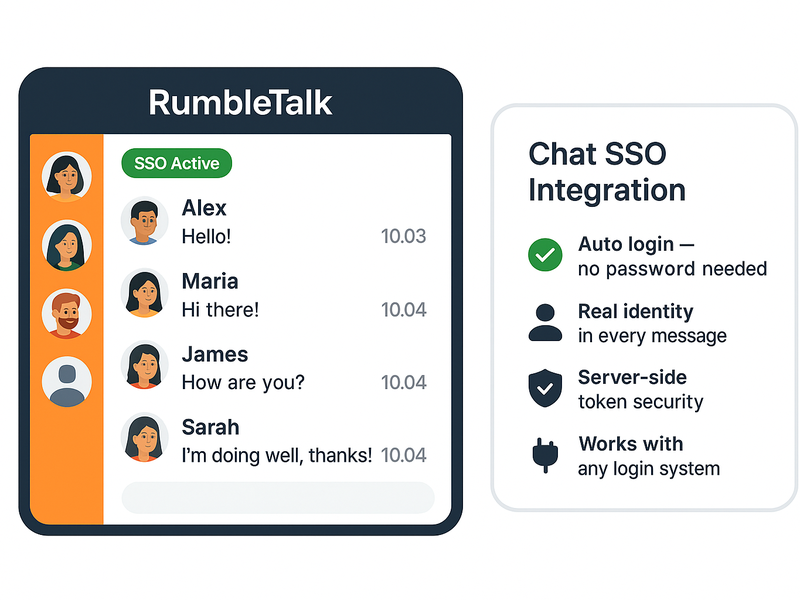
RumbleTalk chat SSO integration — chat window with SSO Active badge and feature list panel

Two Ways to Set Up Chat SSO Integration with RumbleTalk

RumbleTalk offers two implementation paths. One requires no code at all. The other gives developers complete control over the authentication flow. Both achieve the same result: your users are in the chat with their real identity, automatically.

Option 1: The WordPress Plugin (No Code Required)

If your platform runs on WordPress, the RumbleTalk WordPress plugin handles SSO out of the box. Once the plugin is installed and your chat room is connected to your WordPress site, every logged-in WordPress user who visits a page with the chat widget is automatically signed into the chat using their WordPress credentials.

Their WordPress display name becomes their chat username. Their WordPress avatar appears as their chat profile photo. There is nothing for the user to click, configure, or remember. It simply works the moment they load the page.

For site owners running membership plugins like MemberPress, Restrict Content Pro, or BuddyBoss, this is particularly powerful. Your membership tiers are already controlling who can access which pages — RumbleTalk respects that same access control and only puts authenticated members into the chat room.
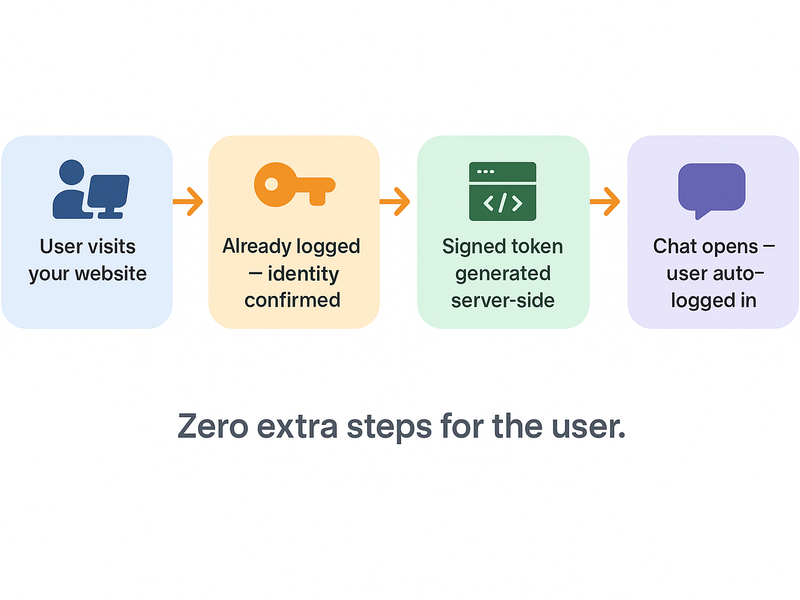

Chat SSO integration flow diagram — four steps from website login to automatic chat access

Option 2: The RumbleTalk SDK and Auto-Login API

For platforms built outside WordPress — custom web applications, React frontends, Angular apps, or any server-rendered platform — RumbleTalk provides an Auto-Login API that gives developers direct control over the SSO handshake.

The flow works like this: when an authenticated user loads a page with your chat embed, your server generates a signed token containing the user’s identity (username, display name, avatar URL). That token is passed to the RumbleTalk SDK, which validates it and logs the user into the chat room automatically — all within the page load, invisible to the user.

The RumbleTalk SDK supports this through a simple JavaScript call:

RumbleTalk.SSO({
  hash: "YOUR_CHAT_HASH",
  username: currentUser.name,
  image: currentUser.avatarUrl,
  token: serverGeneratedToken
});

The token is generated server-side using your RumbleTalk API key, ensuring it cannot be spoofed by a client. This approach works with any backend language — PHP, Node.js, Python, Ruby, or any platform that can generate an HMAC-signed string.

Full documentation and code examples for every major language are available in the RumbleTalk Auto-Login API reference.

Who Benefits Most from Chat SSO Integration

Chat SSO integration solves a specific problem: the gap between your platform’s identity system and the chat room. Any website where users are already logged in before they reach the chat can benefit. Here are the most common use cases.

Members-Only Communities

Subscription communities, professional networks, alumni platforms, and private clubs all have one thing in common: membership is earned or purchased. Asking members to create yet another account to use the community chat undermines the exclusivity and the experience you have built.

With SSO, the chat room becomes an extension of your membership. Members log in once and are instantly part of the conversation. Their identity is verified. Their membership tier can even determine which chat rooms they can access. The result is a cohesive, premium experience that feels like one platform — because it is.

Live Events and Webinars

Event organizers face a specific version of this problem. Attendees have already registered for your event. They received a ticket. They confirmed their email. When they arrive at the event page and find a chat widget asking them to register again, the experience breaks.

With RumbleTalk’s chat SSO integration, attendees who are logged into your event platform are automatically placed into the event chat room. No extra step. No confusion. The moderator sees real attendee names — not anonymous guests — which makes Q&A sessions, polls, and moderation dramatically easier to manage.

Online Courses and Educational Platforms

Course platforms need real identity in the classroom chat. When a student asks a question, the instructor needs to know who is asking — their name, their enrolled course, and whether they are a current student. Anonymous chat in an educational context creates noise, not learning.

SSO integration means every student who joins the course chat is already verified as an enrolled learner. Instructors can address students by name. Moderators can take action on real accounts. The classroom stays focused and productive.
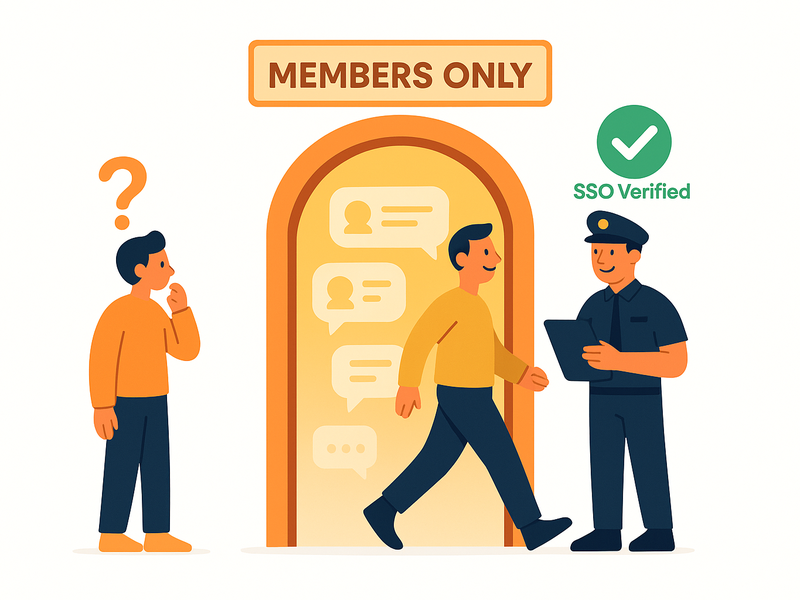

RumbleTalk members-only chat room with lock icon and authenticated attendees in a live event Q&A

What Users Experience with SSO Enabled

The user experience with SSO active is as close to invisible as a login system can get. There is no visible authentication step. No redirect to a login page. No popup asking for credentials. The user simply arrives at the page and finds the chat room open, with their name already in it.

This matters more than most platform owners realize. Every extra step between a user and the community is a point of failure. Some users will not know how to create a chat account. Others will use a different email and appear as a stranger to the community. Many will simply skip the chat entirely if it requires effort.

SSO removes all of that. The chat room becomes an ambient feature of your platform — always there, always ready, always showing the right identity.

What Admins and Moderators Get

From the moderation side, SSO transforms the chat room from an anonymous space into an accountable one. Every username in the room corresponds to a real account in your system. If a user misbehaves, the moderator can act on their actual identity — not just ban an anonymous session that they will rejoin immediately under a new name.

For platforms that handle sensitive topics — financial communities, healthcare Q&A, legal support forums — this accountability is not optional. It is a requirement. SSO makes it technically enforceable, not just a policy.

Admins also gain the ability to assign roles based on platform membership. A premium member can automatically receive moderator privileges in the chat. A trial user can be restricted to read-only access. These rules are enforced through the SSO token, which means they cannot be bypassed from the client side.

Security: How the Auto-Login Token Works

A common question about SSO is whether it is secure — specifically, whether a malicious user could forge a token and impersonate another member. The answer is no, and here is why.

The auto-login token is generated server-side, signed with your private RumbleTalk API key, which never leaves your server. The token includes the user’s identity data and a timestamp. RumbleTalk’s servers validate the signature before accepting the login. If a client tries to submit a modified or forged token, the signature check fails and the login is rejected.

This is the same security model used by JWT (JSON Web Tokens) and HMAC-based API authentication across the industry. It is a proven, battle-tested approach to secure identity delegation.

Getting Started with RumbleTalk Chat SSO Integration

If you are on WordPress, start with the RumbleTalk WordPress plugin. Install it, connect your chat room, and SSO is enabled automatically for all logged-in WordPress users. No configuration required beyond the initial setup.

If you are on a custom platform, start with the Auto-Login API documentation. The implementation is a single server-side function that generates a signed token, plus a single JavaScript call to pass it to the chat widget. Most developers complete the integration in under an hour.

In both cases, your chat room goes from anonymous to authenticated — and your community goes from passive visitors to identified, accountable members — without asking anyone to do anything extra.

The Bottom Line

A chat room without identity is just a comments section. Chat SSO integration is what turns a widget into a real community tool — one where every participant is known, moderation is meaningful, and the experience feels like a natural extension of your platform rather than a separate product bolted on.

RumbleTalk makes this available to WordPress sites without any code, and to custom platforms with a single API call. The result is the same in both cases: your users are in the room, with their real identity, before they even notice the chat is there.

Try RumbleTalk free and set up your first SSO-authenticated chat room today.
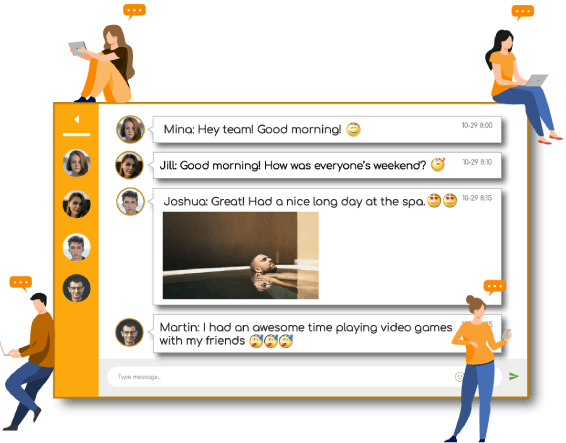
How To Integrate A Chat Room Into Your WordPress Members Plugin?

If your WordPress hosted website has a membership option (plugin), there is a 50% chance that you are using a WordPress members plugin. As you probably know, members-only chat room is something that is essential for community engagement, whether a daily chat or once in a while.

Before we dig into the group chat plugin, let’s first understand the member’s plugin concept. There are several WordPress member plugins, though they all essentially perform the same function. Plugins allow a webmaster to set up a members-only area on their website with exclusive content and special features.

Choosing the right plugin for your site is important, as the various features the plugins offer can affect how many people stay engaged on your website.

Below, we will answer a few questions you may have regarding the integration of a chat room into your WordPress members’ plugins.

What Are Members Chat Rooms?

A members chat room is a chat room that can only be accessed by website members.

Having a members chat room on your website can be helpful. It can encourage site visitors to become members in order to participate in conversations and join the site community.

A chat of today includes also video and audio messages and video and audio live calls.

What Types of WordPress Members Plugin to use?

When in the market for a plugin, it is important to do a little research before making a decision. There are many options out there and we will discuss a few below.

  • MemberPress – MemberPress is a good option when looking for a plugin. It is simple to set up and has quite several features. Webmasters can have a lot of control over who accesses what on their site and at what time. This plugin also conveniently allows for integration with other services you may want to use on your website. Some of these include MailChimp, MadMimi, and BluBrry. The company uses PayPal and Stripe, making it easy for members to make payments. You can choose from two versions of this plugin, either the Business Edition or the Developer Edition. Users of MemberPress often say that this plugin is one of the simplest to use with WordPress, especially for beginners.
  • Paid Memberships Pro – This plugin offers a couple of options. There is a basic version that is entirely free to use, as well as the standard version for a yearly fee and the plus version. Keep in mind the basic free version does not offer many features but may give users a taste of what they can expect in the more advanced versions. Paid Membership Pro also allows for integration with various other services and WordPress members plugins, as well as adding in the Plus version. For users who don’t have a lot of experience working with websites and plugins, this particular one may be rather difficult to use.
  • Ultimate Member – Ultimate Member is yet another option when it comes to plugins. This plugin is extremely simple to use, as no knowledge of coding is required to integrate it into your website. It adapts to mobile devices, allowing users to access members-only content from their computers as well as their mobile devices. Ultimate Member offers a number of extensions that webmasters can pay for, such as Instagram, MailChimp, and User Reviews. There are also a couple of free extensions, like the ability to display what users are online.

How to Integrate a Plugin Into Your Website

We built the RumbleTalk chat room plugin to integrate with most members plugins.
Most WordPress members plugins use the WordPress built-in user management.

RumbleTalk chat room service is integrated with WordPress built-in users management. This means that both the chat and members use the same users base and therefore are integrated by nature, the integration can take practically 1 minute.. (Note, Integration on the chat side is done with one checkbox click, we made it extra easy).


So In practice, what’s next?

You will need the two components installed in your WordPress to create chat room integration.

This can be quite handy because if you have a WordPress Members plugin installed, you can easily incorporate the Rumbletalk plugin into your WordPress website. This will allow you to have a members-only chat room.

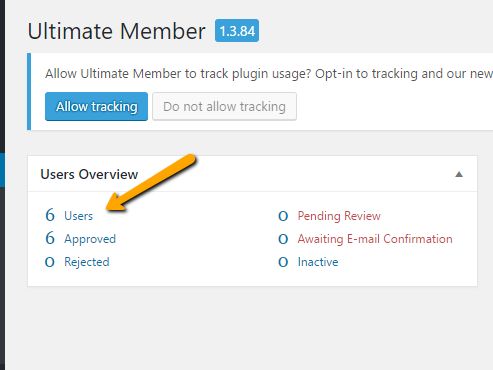
The steps to do so are below (we just use ultimate member as an example).

members plugin with a chat room

Step 1
1 – Install the Member plugin and follow the setup instructions.

2 – Install the  RumbleTalk chat room plugin and follow the setup instructions.

Performing these two steps will automatically integrate the chat with the Members Plugin users base. By doing so, we will allow only members of the site to log in automatically to your chat with their username.

Step 2
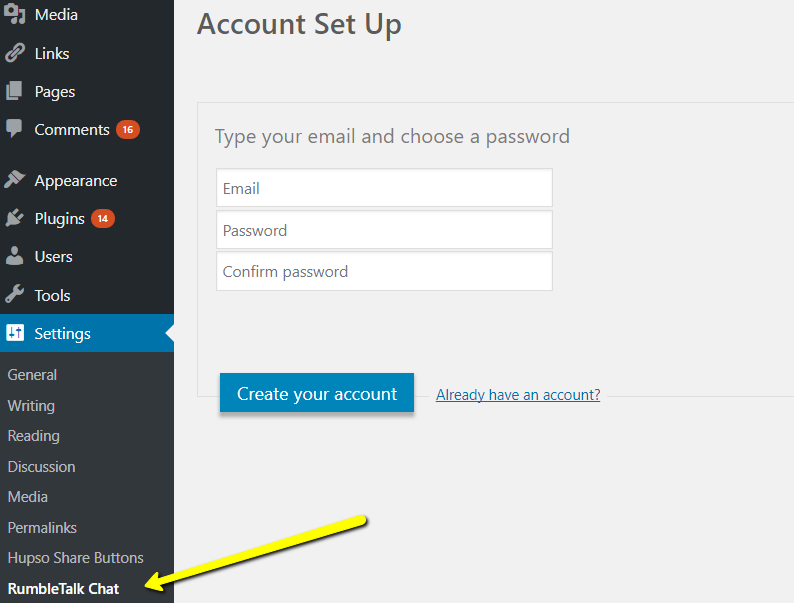
After the installation of the plugins has finished, you then must create an account via the RumbleTalk chat plugin.

Account wordpress setup

Step 3
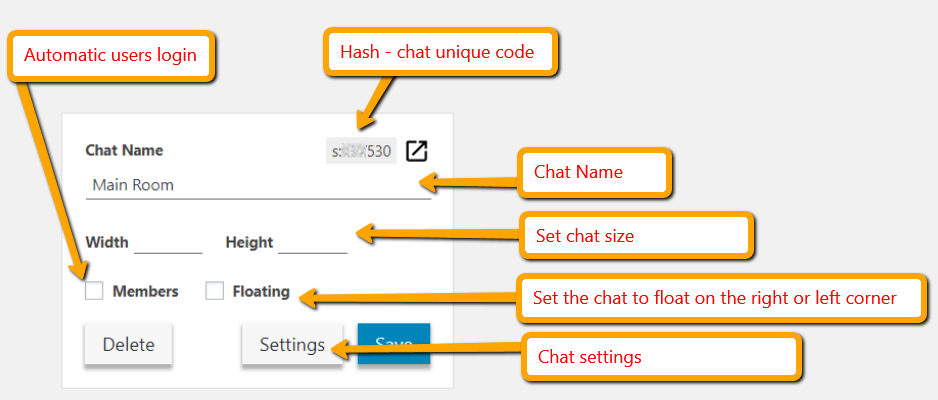
Once done, you will see the window below. Make sure to check the “Member” box to complete the process.

detailed info on the wp plugin

For more information and troubleshooting, check this link

You are done! 

As you can see, it is quite a simple process!  If you need more information about settings or the installation process, you can check out the introductions in here.

For any additional questions or comments, please contact us at support@rumbletalk.com.

27 Easy Chat CSS Tricks for Designing your Own Chat Room (WEB & MOBILE)

Controlling your chat design using group chat with custom CSS is easy with our advanced design features.

RumbleTalk sets itself apart from the competition by being the most customizable group chatroom available on the market. The latest custom css tips and tricks can be found in here.

A lot of our customization features are built into our settings menu, making this customization available to anyone at any tech-literate level, and or CSS experts. RumbleTalk group chat with custom CSS can be completely transformed.

But not everyone knows CSS, so we’ve put together this list of easy chat CSS tricks that anyone can copy and paste into the advanced design tab of their RumbleTalk account to get the benefits of a fully customized group chat room.  (Note, for the mobile version, we have other CSS tricks).

All you have to do is:

  1. Copy the chat CSS code from this list.
  2. Log in to your RumbleTalk admin panel.
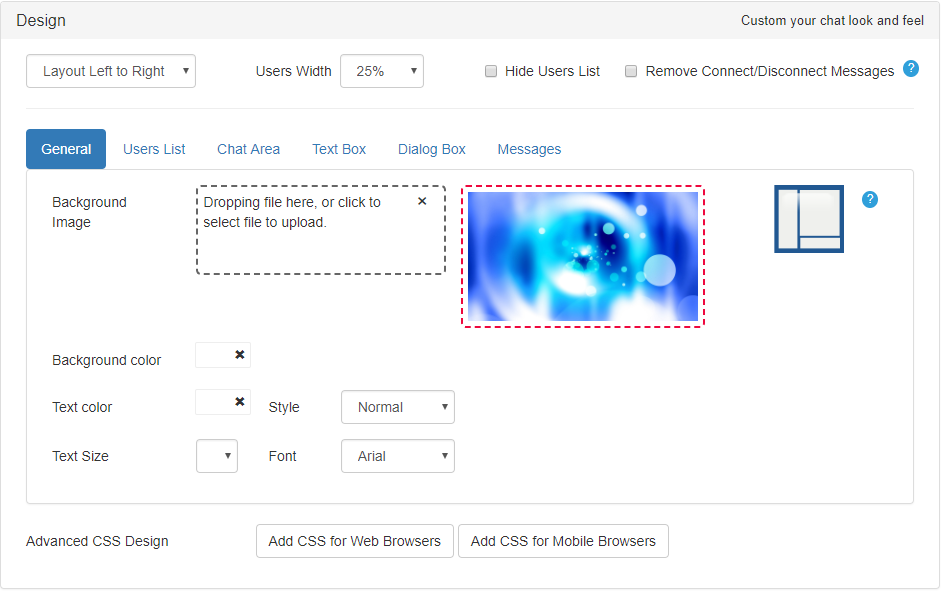
  3. In the chat settings, under “Design”, click on “Add CSS for Web Browsers”.
  4. Paste your code and close the box.

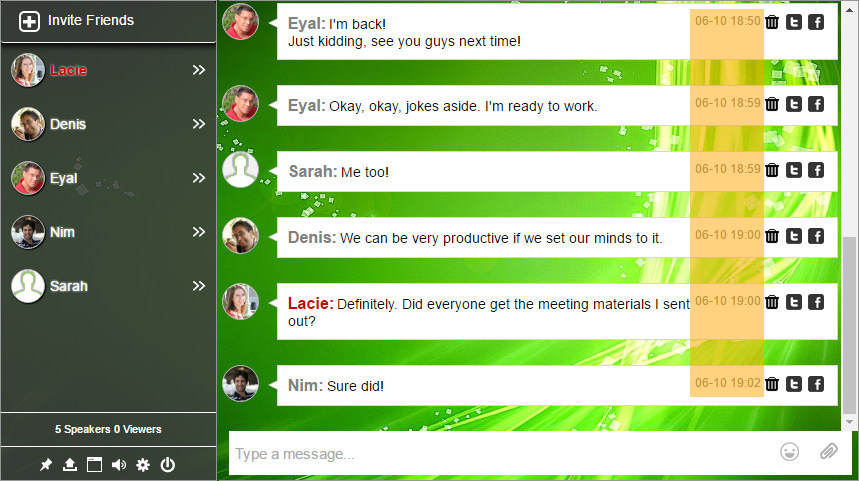
Group Chat Css tricks

In this post, we’ll cover the following chat CSS tricks:

User Icons – Chat CSS tricks

  1. Change the default guest user icon image
  2. Change the user icon size in the user list
  3. Change the user icon size in the chat area
  4. Hide the user icons in the user list
  5. Hide the user icons in the chat area

Functions – Chat CSS tricks

  1. Hide system messages
  2. Hide message date & time
  3. Hide all option buttons
  4. Hide specific option buttons
  5. Insert a clear chat area button
  6. Hide the number of viewers and listeners
  7. Hide the “Go To Facebook Profile” button
  8. Change the emojis

Text – Chat CSS tricks

  1. Change the group chat administrators’ text color
  2. Change the text displayed in the guest login button
  3. Remove the login type label from the user profile
  4. Add borders to the username text
  5. Add borders to the message text
  6. Add an element above the chat in full-screen
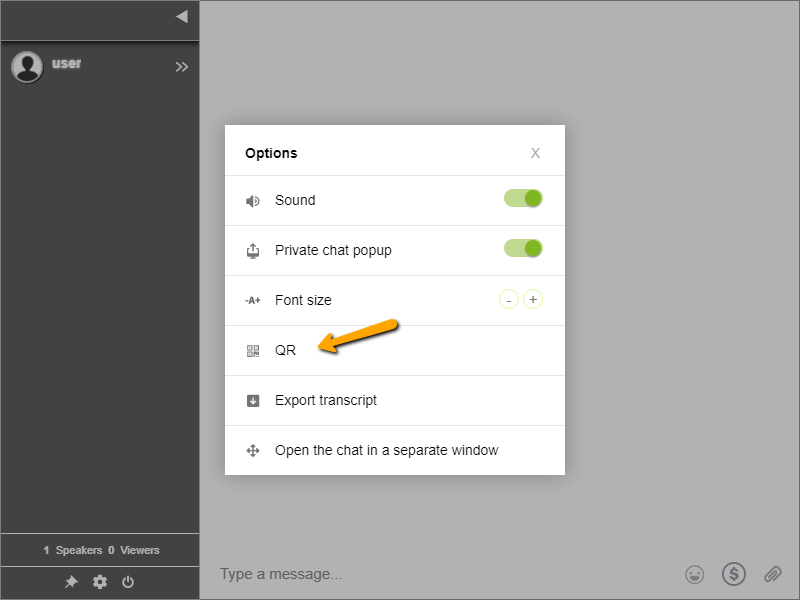
  7. Hide the QR box
  8. Add a closing icon to the floating bouncing icon
  9. Remove the field image and description in the register
  10. Set max image size in a chat
  11. Set max YouTube size in a chat
  12. Hide Twitter Link in Users Profile
  13. Disable group chat and allow only private chats
  14. Hide scrolling for non-moderators

1. Change the default guest user icon image

You can change the guest user icon to any image by inserting the
image URL into the following code.
.guest-default-image {
background: url("https://www.test.com/storage/usericon.png");
}

Group Chat Custom Avatars

2. Change the user icon size in the user list

.user-image {
width: 16px;
height: 16px;
}

large custom user icons

3. Change the user icon size in the chat area

.message-user-image {
width: 16px;
height: 16px;
}

large user icons

4. Hide the user icons in the user list

.user-image { display: none; }

hide user icons in group chat

5. Hide the user icons in the chat area

.message-user-image { display: none; }

hide chat user icons

Note, if you like to remove the white tooltip next to each message, you can use this code
.main-message-container::before,
.main-message-container::after { content: none; }

6. Hide system messages

System messages such as “user joined the conversation” and “user
left the conversation” appear in the group chat area.

.system-message-text { display: none; }

system messages can be turned off

7. Hide message date & time

Each message by default will be stamped with the date and time it
was sent. Use this code to remove this feature.

.message-date { display: none; }

group chat time stamps

8. Hide all option buttons

#options { display: none !important; }

Hide Buttons

9. Hide specific option buttons

Choose the buttons you want to hide. Each of these lines of code
can be copied and pasted individually.

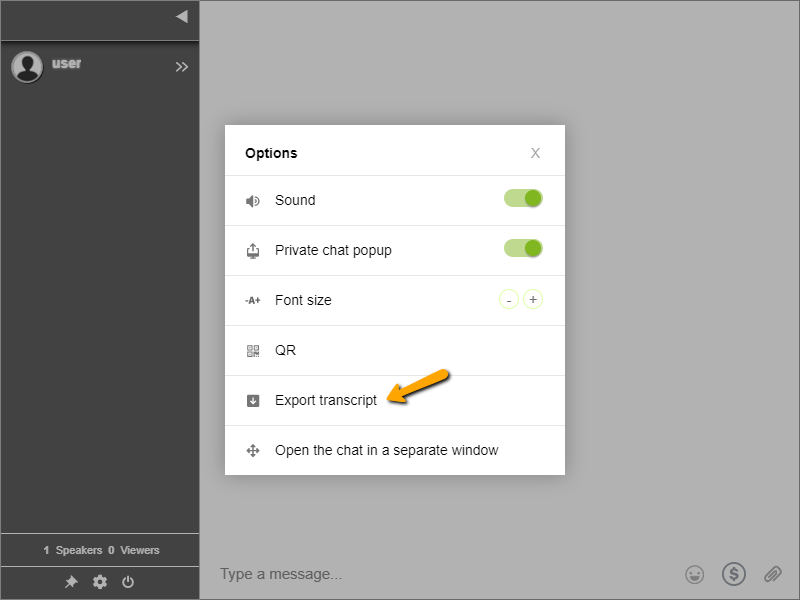
.options-dialog .export {
display: none !important;
}
export chat transcript
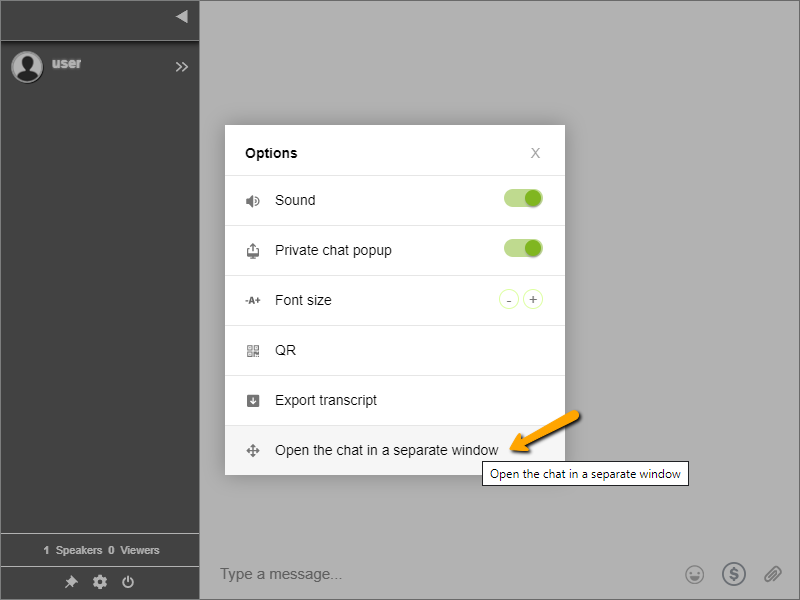
.options-dialog .popup {
display: none !important;
}
chat fullscreen
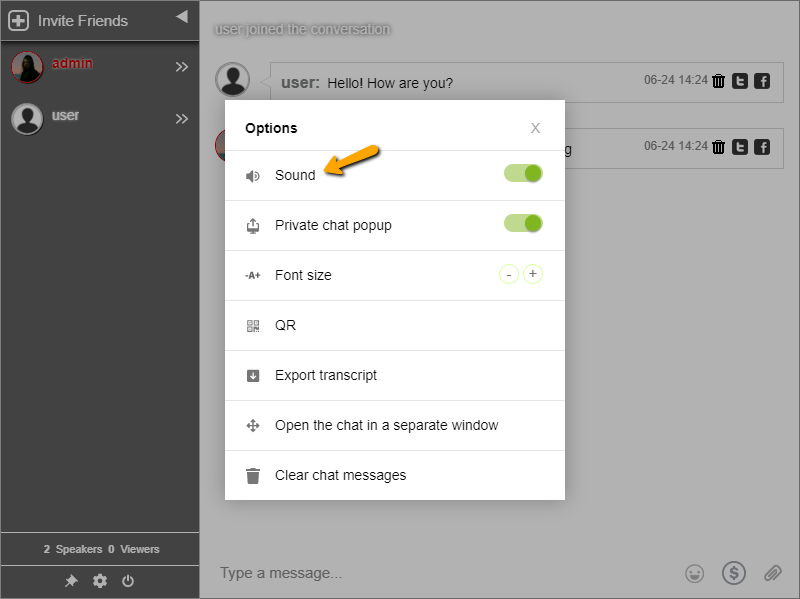
.options-dialog .toggle-sound {
display: none;
}
chat menu

.options-dialog .qr-option { display: none !important; }

qr code

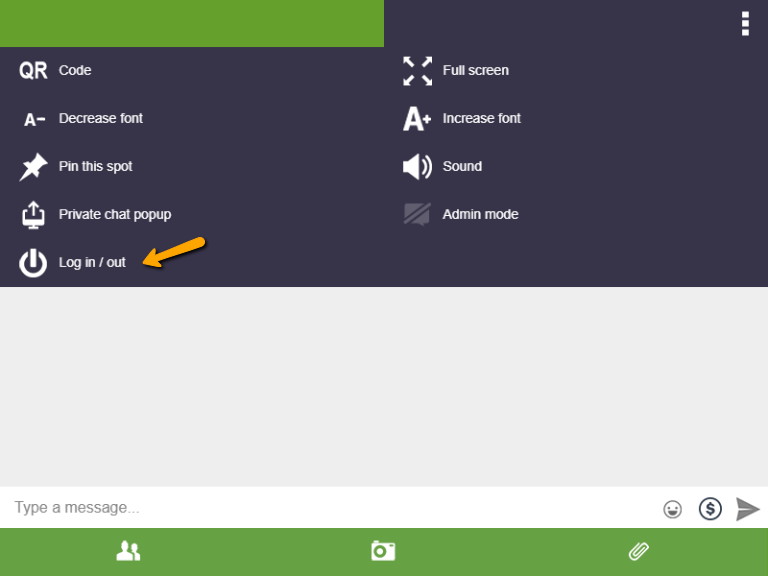
.options-dialog .logout { display: none !important; }

/* This option only applies to mobile */

logout mobile

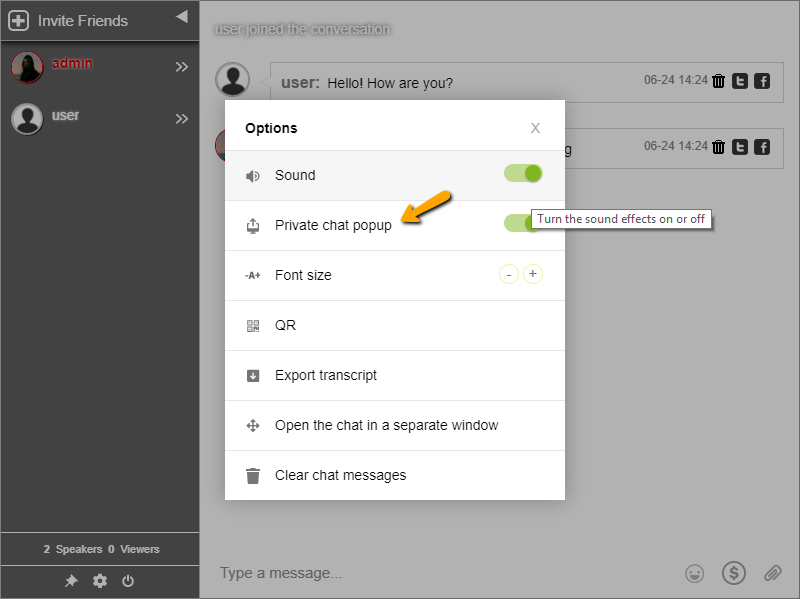
.options-dialog .toggle-private {
display: none;
}
chat menu

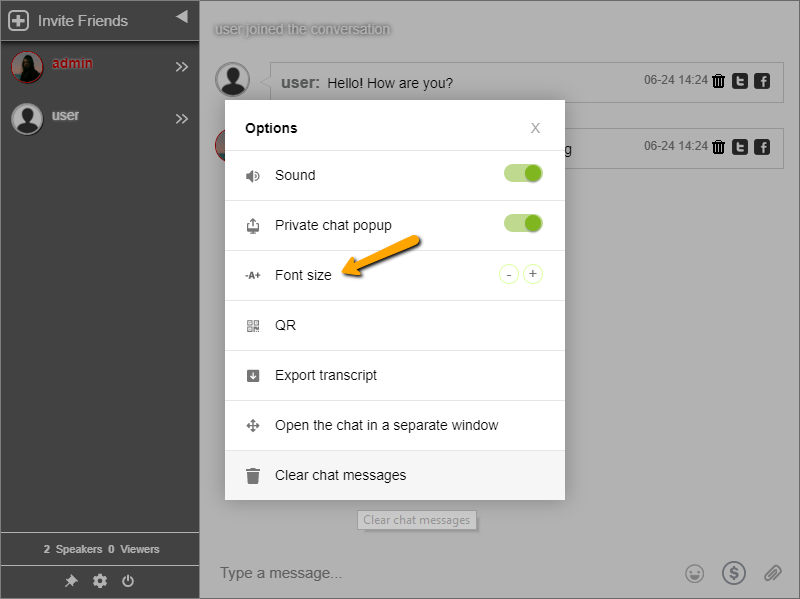
.options-dialog .font-size {
display: none;
}
chat menu

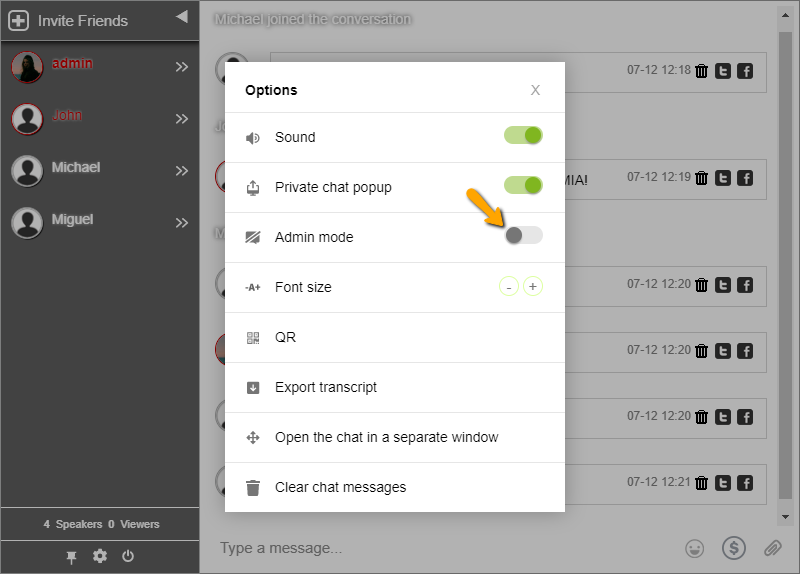
.options-dialog .admin-mode-switch {
display: none !important;
}

/* This option can only be applied by admins */chat tool

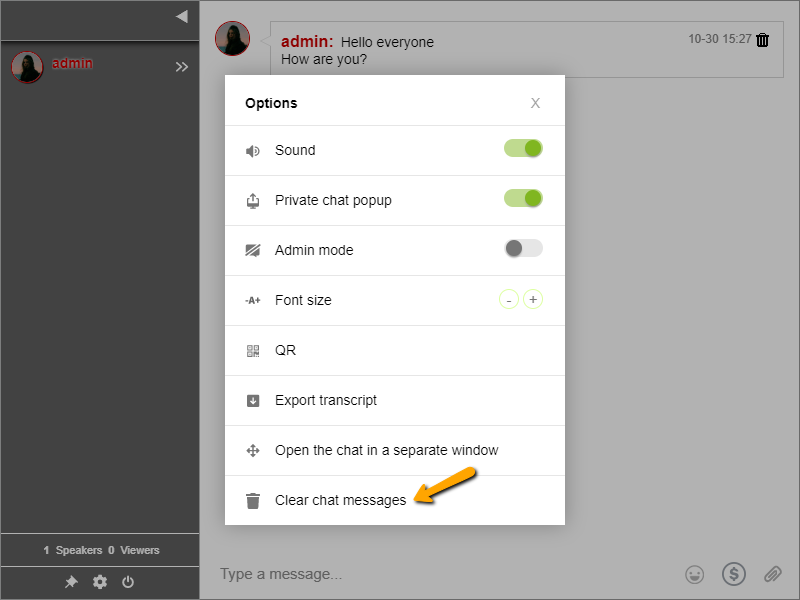
.options-dialog .clear-messages {
display: none !important;
}

/* This option can only be applied by admins. */clear chat messages

10. Insert a clear chat area button

By default, the clear all button is hidden. Insert this button if you
want to have the option to clear all options without deleting them.

#options #clear { display: inline-block !important; }Group Chat Clear All Button

11. Hide the number of viewers and listeners

By default, the number of viewers and listeners is displayed in the
chat. Add this code to remove it.

#info { display: none !important; }

Group Chat Audience

12. Hide the “Go to Facebook Profile” button

When a user uses Facebook to log into the chat, a button will by
default appear in their group chat profile for others to go to their
Facebook profile. Use this code to remove that option.

#user-info .facebook-button { display: none !important;}

Facebook Profile Button

No Facebook Profile Button

13. Change the emojis

Use the following code for each emoji, where the number 10 represents one of the emojis (from 1 to 33, excluding 6), and the URL represents the image you want to replace it with.

.smiley-10 {
width: 0 !important;
padding-right: 30px;
background-image: url("https//www.exampleurl.com/smile2.gif");
height: 30px;
}

Customize Group Chat Emoji's

14. Change group chat administrators text color

Set yourself apart as the group chat administrator by changing the
color of your username and message text. By default the color is red.

Group Chat Administrator

In the user list

.admin .user-name { color: orange; }

In the group chat

.admin .message-user-name { color: orange; }

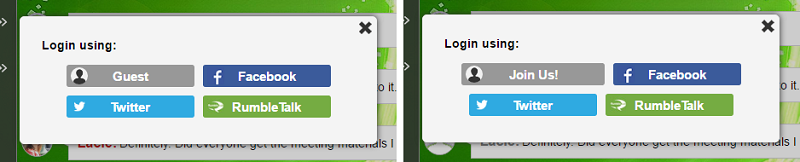
15. Change the text displayed in the guest login button

Replace the text “new name” but be certain to leave the (‘) marks
around it.

“color: #000” is the color of the text. In this case, the text will
be black. You can change this with any hex code.

“-20px” is the relative horizontal location of the text. Play with
this value until the text sits in the center.

#login-guest span {
color: transparent !important;
position: relative;
}
#login-guest span:after {
content: 'Join Us!';
position: relative;
color: #fff;
left: -20px;
}

Custom Guest Login Text

16. Remove the login type label from the user profile

.login-type { display: none; }

Group Chat Login Option

17. Add borders to the username text

This code will add black and bold borders to the usernames in the chat message area.

.message-user-name{
font-weight: bold;
color:rgba(0,150,245,1.00);
text-shadow: -1px 0 black, 0 1px black,
1px 0 black, 0 -1px black;
}

Bold User Names

18. Add borders to the message text

This code will add black and bold borders to the text in the chat area.

.message-text{
color:#fff;
text-shadow: -1px 0 black, 0 1px black,
1px 0 black, 0 -1px black;
font-weight: bold;
}

Bold Message Text

19. Add an element above the chat in full screen

Many ask us how I can add a player on top of the chat area.
The following code will be added to your HTML (not on the RumbleTalk CSS area) in full screen.

<style>
<inner element height> - the height of the extra element
#wrapper { height: 100%; }
#extra-element {
width: 100%;
height: <inner element height>;
padding: 0px;
}
#chat-wrapper {
position: relative;
width: 100%;
height: 100%;
}
<chat-iframe> {
max-height: calc(100% - <inner element height>);
}
</style>
<div id="wrapper">
<div id="extra-element">THE CODE YOU WANT TO BE ON TOP OF THE PAGE </div>
<div id="chat-wrapper">THE CHAT CODE</div>
</div>

add external player on top of your chat.

20. Hide the QR box

When you want to hide the QR option in your chat.

QR code hide

To remove the button, add the following:

.options-dialog .qr-option { display: none !important; }

To keep the button for chat moderators only, add the following:

.moderator #options #opts { display: list-item; }

21. Add closing icon to the floating bouncing icon

If you want to add a closing icon to the floating icon. You can add this code and make sure you change the hash code (in red).
(function(){
var hash = 'YOUR_HASH',
handle;


handle = setInterval(
function () {
if (
!window.RumbleTalkChat ||
!window.RumbleTalkChat[hash] ||
!window.RumbleTalkChat[hash].mainDiv
) {
return;
}


clearInterval(handle);
if (hash == 'YOUR_HASH') {
throw new Error('Someone forgot to replace the place holder "YOUR_HASH" with your chat\'s hash');
return;
}


var img = new Image();
img.src = 'https://d241b8qep9dzid.cloudfront.net/20190625083406/italic.png';
img.style.cursor = 'pointer';
img.style.position = 'absolute';
img.style.bottom = 0;
img.style.right = 0;
img.onclick = function () {
window.RumbleTalkChat[hash].mainDiv.parentNode.removeChild(window.RumbleTalkChat[hash].mainDiv);
};


window.RumbleTalkChat[hash].mainDiv.appendChild(img);
},
100
);


}());

22. Remove the image and description of the field in the register dialog box

Remove the field image and description from the registration form.
.register-login-dialog form .row:nth-child(n+4) {
display: none;
}

23. Set max image size in a chat

Add the maximum size of an image to the chat conversation. Clicking on a small image will open it in its original size.
.message-text a img {
max-width: 200px !important;
max-height: 200px;
}

24. Set max YouTube size in a chat

Add the maximum size of a YouTube video in a chat. Clicking on a small image will open it in its original size.

.message-text .youtubeWrapper {
max-width: 300px !important;
max-height: 300px;
  padding: 0;
height: auto;
}
.youtubeWrapper > iframe {
height: auto;
position: static;

}

25. Hide the Twitter Link in user profile

Hide Twitter Link in user profile (when clicking on the gear icon in the private chat ).
.twitter-button {
display: none;
}

26. Disable group chat and allow only private chats

If you want to allow only private chat discussion so all can talk in private but not have a group discussion then choose a chat type “Group chat”, and then add the following CSS to both the web and mobile CSS versions.
#content,
#text:not([readonly]),
#chat-extra,
#send-button
{ display: none !important; }

27. Hide scrolling for non-moderators

If you want to prevent the scrolling of the chat message area – which will prevent regular users from accessing old messages, add the following CSS code to both the web and mobile CSS versions:

body:not(.moderator) #chat {
overflow-y: hidden;
}