What a Professional Chat Room Service Can Add to Your Platform

Adding real-time communication to a website or platform is no longer optional. Whether you run an online community, a members-only portal, a livestreaming website, a gaming hub, or an online classroom, users expect immediate interaction. A Chat Room Service is the most efficient, cost-effective way to deliver this without building complex real-time infrastructure from scratch.

But not every chat tool offers the same depth, reliability, or flexibility. A basic chat box might allow messages to appear on the screen, but a professional Chat Room Service gives your platform organization, performance, and long-term stability. It becomes part of your ecosystem, rather than just an extra widget.

This article walks through the advantages a professional Chat Room Service brings to your platform, how it improves user engagement, and what technical features developers can rely on to build a seamless experience.

Why a Chat Room Service Matters More Than Ever

Communication is at the heart of digital interaction. Users want to ask questions, meet others, get support, take part in discussions, or join live events. A Chat Room Service creates a space for all these interactions to happen instantly.
online event technology

It increases platform stickiness, encourages community building, improves user satisfaction, and supports real-time participation during classes, events, or broadcasts. When users can communicate without friction, they stay longer, learn more, and connect with your content on a deeper level.

Instant Setup With No Infrastructure Work

Developing your own real-time chat system requires the following:

  • WebSocket servers
  • Security layers
  • Moderation functionality
  • Multi-room logic
  • Custom UI development
  • Ongoing server maintenance
  • Mobile optimization
  • Scaling for large audiences

A professional Chat Room Service eliminates all of that. You simply embed it on your platform, and within minutes, your users have access to a stable, fully functional chat environment.

Chat can be placed:

  • On landing pages – to instantly capture visitor attention and answer questions before they leave.
  • On livestream pages – to boost engagement by letting viewers chat in real time alongside the broadcast.
  • Inside members-only areas – to give paying users a private, exclusive space to interact and build community.
  • On support pages – to offer fast, real-time help that reduces tickets and solves issues quickly.
  • Inside online classrooms – to let students ask questions, join discussions, and collaborate during lessons.
  • Within WordPress via plugin – to add a fully managed chat experience to any WP site with zero coding required. Each placement adds a powerful communication channel without requiring additional engineering resources.

Organizing Communication With Multiple Rooms

One chat room rarely meets the needs of larger platforms. A professional Chat Room Service also lets you create multiple rooms for different purposes, improving clarity and user experience.

Examples include:

  • A main room for general discussion
  • A separate Q and A room
  • Support and technical help rooms
  • Members-only or private rooms
  • Event or session-specific rooms
  • Topic-based discussion rooms
  • Teacher or instructor rooms
  • Breakout rooms for online classes

This structure prevents message overload and keeps communication highly organized.

Moderation Tools That Keep Everything Under Control

Large audiences require guidance, and a Chat Room Service gives you everything needed to maintain a safe, focused, and productive space.

Moderators can:

  • Approve messages before they appear
  • Remove inappropriate content
  • Pin announcements or instructions
  • Highlight teacher or admin messages
  • Block or mute disruptive users
  • Monitor all rooms from a single panel
  • Review chat history anytime

These tools help communities, students, customers, and event attendees communicate without chaos.

Auto-Login for Seamless User Identity

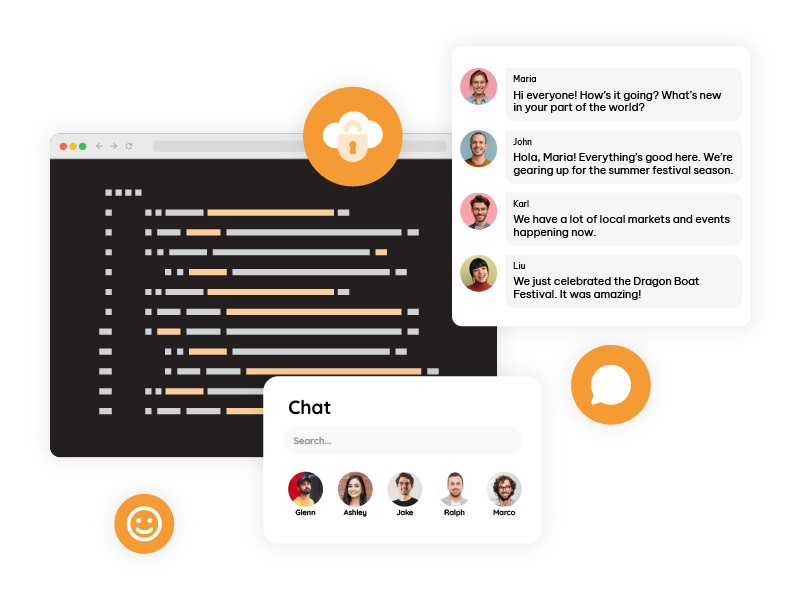
A professional Chat Room Service includes Auto-Login integration, allowing you to pass your platform’s user identity directly into the chat. When a user logs into your site, the chat automatically detects their account and displays their correct name.
chat room service

This enables features such as:

  • Username consistency
  • Preventing impersonation
  • Exclusive room access for members
  • Role-based permissions
  • Secure identity handling

Perfect for membership platforms, LMS systems, online academies, and any platform that needs controlled access.

Using the SDK to Customize the Chat Experience

Developers who want deeper control can use the Chat Room Service SDK to modify how the chat behaves and integrates into the platform.

You can:

  • Inject user roles dynamically
  • Change the chat UI
  • Show or hide features based on subscription level
  • Load specific rooms depending on the page
  • Trigger chat events from your platform logic
  • Insert the chat into modals, dashboards, or custom layouts

The SDK ensures the chat feels seamless and native to your platform.

Advanced Automation With the REST API

For platforms that operate at scale, automation becomes important. The REST API allows complete control of chat room management.

You can:

  • Create rooms automatically
  • Delete rooms on demand
  • Assign users to specific rooms
  • Update themes or settings remotely
  • Generate temporary private rooms
  • Sync permissions with your internal user system

This allows LMS platforms, membership sites, and large event systems to integrate the Chat Room Service directly into their workflow.

Saving Chat History for Users and Admins

A professional Chat Room Service offers built-in conversation history, which is incredibly valuable across different industries.
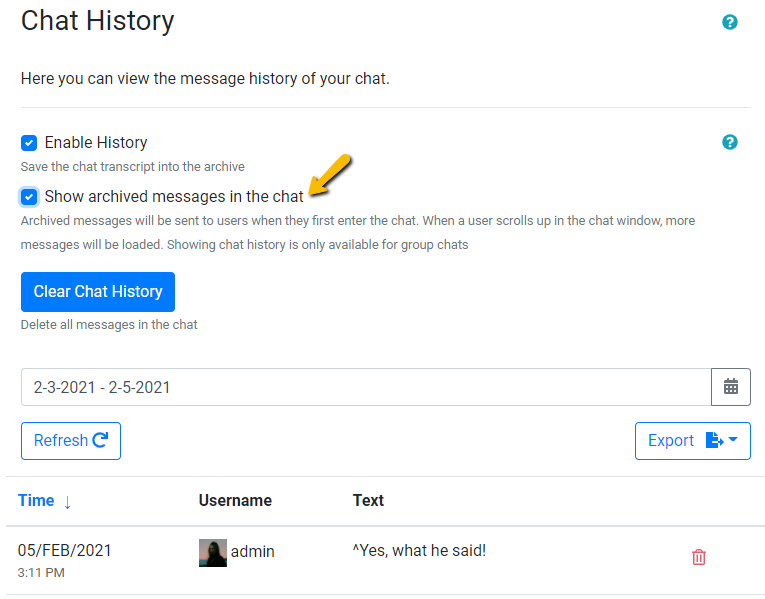
Chat history enables:

  • Students to review classroom discussions
  • Event hosts to revisit Q and A sessions
  • Support teams to follow up on past issues
  • Teachers to verify participation
  • Community managers to analyze engagement
  • Businesses to store logs for compliance

Whether for learning, support, or analysis, conversation history adds long-term value and transparency.

Embedding Chat Beside Live Video

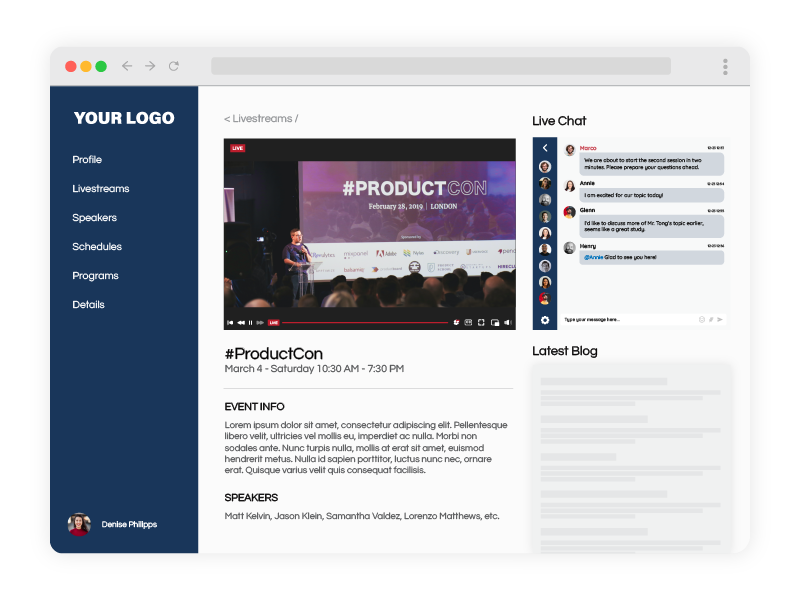
One of the most powerful uses of a Chat Room Service is placing it next to a livestream. In addition, this transforms a regular video into an interactive experience.

Supported formats include the following:

Chat beside video is ideal for:

  • Online classes
  • Corporate webinars
  • Product launches
  • Virtual events
  • Live shows
  • Town halls
  • Coaching sessions

Users stay engaged because they watch and participate simultaneously.

Custom CSS for a Fully Branded Experience

Your platform’s brand identity matters. A Chat Room Service that supports full CSS customization lets you make the chat look exactly how you want.

You can style:

  • Backgrounds and message bubbles
  • Fonts and colors
  • Borders and spacing
  • The user list
  • The header and footer
  • Input fields and buttons
  • Room themes and accents

This ensures the chat blends seamlessly with your website or app design.

What a Professional Chat Room Service Adds to Your Platform

Real-time community

Live chat offers users the chance to interact instantly, which builds a natural sense of community. Instead of passively consuming content, people talk, react, ask questions, and help each other. This transforms your platform from a static page into a vibrant social environment where users return again and again.

Organization through multiple rooms

Multiple rooms keep discussions clean and focused. Users instantly know where to go: support in one room, Q and A in another, private discussions in a third. This prevents overcrowding, avoids repeated questions, and gives every topic its own space.

Strong moderation tools

A Chat Room Service gives moderators complete control over the environment. They can filter messages, pin announcements, mute disruptive users, highlight important instructions, and keep conversations safe. This level of control is essential for busy classes, livestreams, and communities.

Auto-Login identity sync

Auto-Login ensures that users never have to authenticate twice. Your own login system automatically synchronizes with the chat, passing usernames securely and granting role-based access. This creates a unified user experience across your entire platform.

SDK customization

With the SDK, the chat becomes a native part of your platform. You can control user roles, adjust the interface, connect the chat with your own logic, and load rooms dynamically. This is ideal for developers who want maximum flexibility without building a chat system.

REST API automation

The REST API enables full automation. From generating rooms automatically to assigning users based on enrollment, everything can be managed programmatically. This is essential for large LMS systems or event platforms that require hands-free scaling.

Chat history preservation

Chat logs provide long-term value. Users can revisit discussions, teachers can track participation, support teams can follow cases, and businesses can keep compliance-ready logs. This transforms chat into a searchable knowledge asset.

Side-by-side video and chat

Placing the chat next to live video turns any broadcast into a social experience. Viewers stay longer and participate more, creating real-time interaction around lessons, events, or product launches.

Private and restricted rooms

Private rooms allow you to create exclusive spaces for premium members, teams, or specific student groups. Moreover, access is automatic and secure, thanks to Auto-Login and API-based permissions.

Fully branded design

Custom CSS lets you match the chat to your brand perfectly. Fonts, colors, backgrounds, and layout can all be adapted so the chat aligns visually with your platform.

High scalability

A professional Chat Room Service handles sudden traffic spikes without lag. Whether you have 50 users or 100,000 users, the chat stays fast and stable. This reliability is critical for large events, online courses, or high-traffic communities.
Give Your Members a Trading Chat Widget They’ll Open Every Session

A trading chat widget is the difference between a platform your members check once a day and one they keep open all session long. When traders can talk in real time, share signals, react to price moves, and ask questions, your platform becomes the place they work from. Not just the place they log into.

Most trading platforms are built around data: charts, watchlists, screeners, and alerts. What they often miss is the human layer. Traders do not make decisions in isolation. They watch how others react to the same data. They share observations. They ask whether anyone else is seeing what they are seeing. That conversation happens somewhere. If it does not happen on your platform, it happens on Discord, on Telegram, or in a private group your members built without you.

A trading chat widget embedded directly in your platform keeps that conversation where it belongs. It stays inside your product, visible to your community, and under your moderation.

Why Traders Keep Chat Open All Session

Trading is a time-sensitive activity. A signal that matters at 9:35 AM is irrelevant by 9:50. The conversation around that signal, including who saw it, who acted, and what happened, must occur in real time. This is fundamentally different from a forum post or comment thread, where replies arrive hours after the moment has passed.

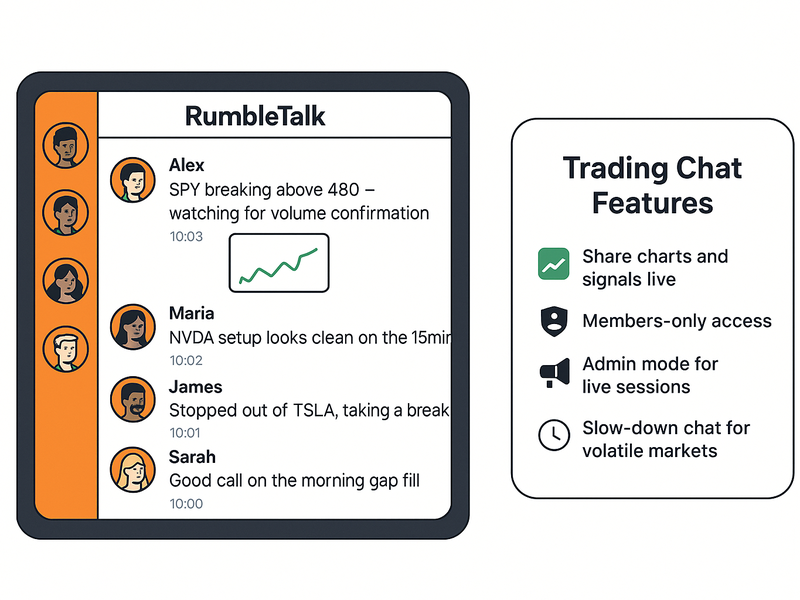
A live trading chat widget feeds that real-time need. Members post observations as the market moves. They tag each other on setups. They share screenshots of charts mid-session. As a result, the chat becomes a live feed of collective attention. That feed is inherently sticky. Once a trader is in the habit of watching it, they do not close it.

This is why platforms with embedded chat see higher session length and return visit frequency than those without it. The chart might be the reason a member signs up. However, the chat is the reason they stay.

RumbleTalk trading chat widget showing live member discussion with stock signals and file sharing

Members-Only Access: Your Community, Your Rules

Not every trading chat should be open to the public. If your platform serves a paid subscriber base, a private trading club, or a members-only research service, your chat room should reflect that exclusivity. RumbleTalk’s trading chat widget gives you full control over who can enter the room.

You can configure the chat to accept only registered users. Anyone who tries to open the widget without an active account on your platform is blocked at the door. In addition, when combined with SSO integration, your existing login system becomes the key. Members who are logged into your platform are automatically logged into the chat. No second account. No separate password. No friction.

This matters more than it might seem. A trading community is only as valuable as the quality of its participants. When you control who is in the room, you control the signal-to-noise ratio. Every message comes from a verified member of your platform, someone with skin in the game and a reason to contribute meaningfully.

Share Charts, Files, and Market Data Right in the Chat

Text is not enough for traders. The most useful contributions in a trading chat are visual. For example, members share a chart showing a breakout pattern, a screenshot of an options chain, a PDF of a research report, or a pie chart of portfolio allocation. RumbleTalk’s trading chat widget supports file sharing natively. Members can attach images, documents, and charts directly to their messages without leaving the platform.

This turns the chat from a conversation into a working environment. Members are not just talking about trades. They are showing their reasoning, in real time, to the whole room. That transparency builds trust and speeds up learning. Junior members learn by watching how experienced traders communicate their setups. Furthermore, experienced traders benefit from the accountability of sharing their thinking publicly.

The result is a chat room that functions more like a trading desk than a social feed. That is exactly the kind of environment members return to every single session.

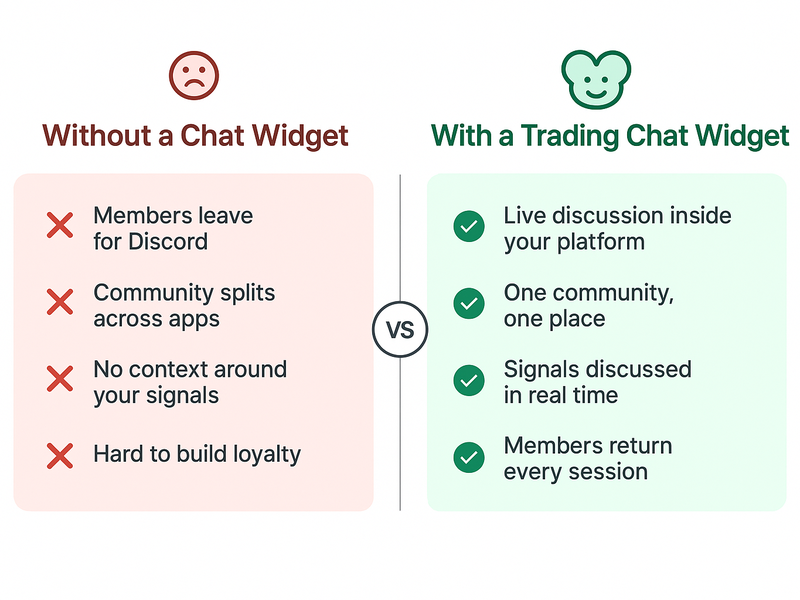
Comparison showing platform without trading chat widget versus with it showing engagement and retention difference

Moderation: Keep the Room Focused on What Matters

A trading chat without moderation quickly becomes noise. Off-topic messages, promotional spam, and low-quality posts degrade the experience for serious members. Serious members leave. RumbleTalk gives platform administrators three tools to keep the room productive.

Message Pre-Approval

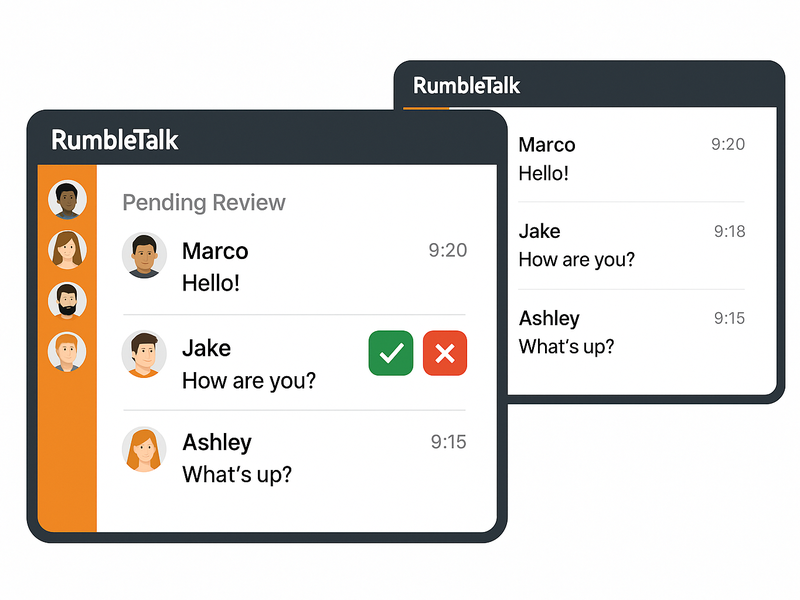
Every message a member posts goes into a moderation queue before it appears in the room. Moderators see the message and approve or reject it with a single click. This is the highest level of control. Nothing reaches the room that has not been reviewed first. This approach is particularly useful for platforms where the chat is used for live trade recommendations or regulated financial advice.

Admin Mode

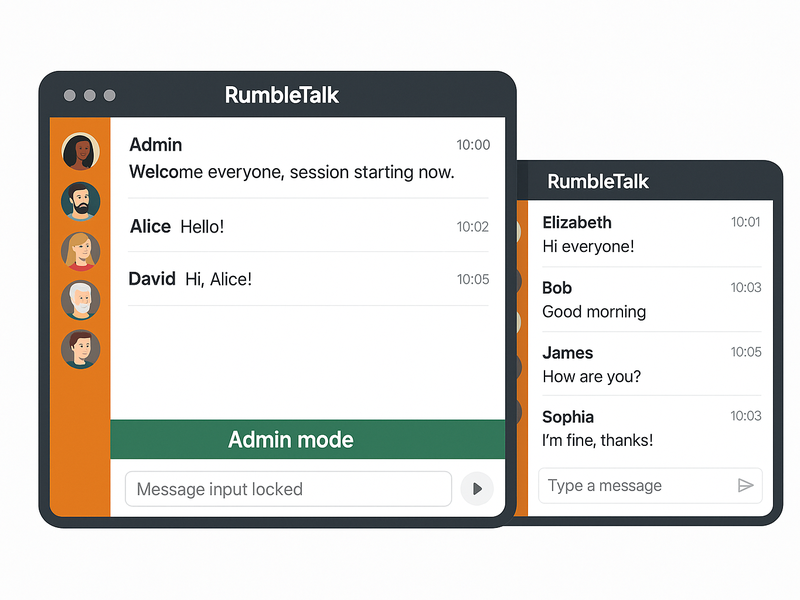
When a host or expert is presenting, such as during a live trading session, a market open commentary, or an earnings reaction, you can activate Admin Mode. This silences all regular members and allows only administrators and designated speakers to post. As a result, the room stays focused on the presenter without interruption. Members can still read and follow along. They just cannot post until the presentation ends and Admin Mode is lifted.

Slow-Down Chat

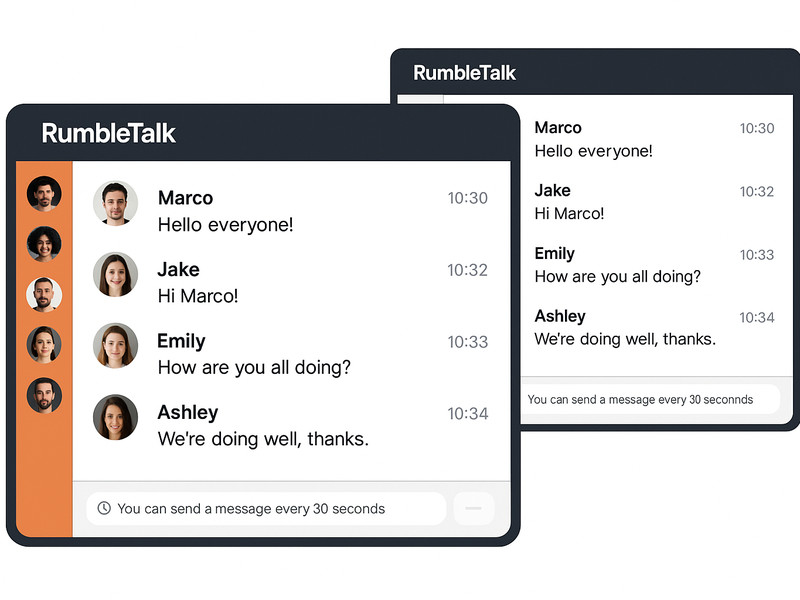
During high-volatility periods, such as a major earnings announcement, a Fed decision, or a sudden market move, chat rooms can flood with rapid-fire posts. These posts scroll past too fast to read. Slow-Down Chat lets you set a cooldown period between messages from each member. Every member can still participate, but the pace of the conversation stays readable. In other words, the signal stays visible in the noise.

Private Chat: One-on-One for Deeper Conversations

Not every trading conversation belongs in the group room. A member who wants to ask a detailed question about a specific setup, a subscriber who wants to discuss their portfolio with an advisor, or a mentor working through a trade with a student, these conversations are better handled privately.

RumbleTalk’s private chat feature allows any two members to open a direct conversation from within the platform. The private chat supports text, file sharing, and audio and video calls. Therefore, deeper discussions can move from text to a face-to-face conversation without switching apps. Everything stays inside your platform.

For trading advisory services, this is particularly valuable. Members who pay for premium access can get direct time with advisors through the same interface they use for the group chat. The platform becomes the complete communication environment. No more Zoom links, WhatsApp threads, or email chains.

Trading community concept illustration showing traders connected through a chat hub with market data and discussion

Embedding the Widget: Simpler Than You Think

The technical lift for adding a trading chat widget to your platform is minimal. RumbleTalk provides an embed code, which is a short HTML snippet, that you paste into any page on your website. The chat room loads inside your existing layout, inheriting your site’s look through customizable themes. There is no server infrastructure to set up, no database to manage, and no maintenance overhead on your end.

For WordPress-based platforms, the RumbleTalk plugin handles the embed automatically. For custom platforms built on React, Angular, Vue, or any server-rendered stack, the JavaScript SDK gives developers full control over placement, sizing, and user authentication. Moreover, most development teams complete the full integration, including SSO, in under a day.

Once embedded, the widget scales automatically. Whether your community has 50 active members or 5,000 in the room at once, the infrastructure handles the load. No action is required on your part.

What Your Members Actually Get

From the member’s perspective, a well-implemented trading chat widget feels like a natural part of the platform. It is not a bolt-on addition. They log in, and the chat is already there. It already shows their name. It is already populated with the morning’s activity from other members who joined early.

They can watch the pre-market discussion while reviewing their watchlist. They can drop a chart into the room when they spot a setup and get immediate reactions from other members. They can follow the admin’s live commentary during the market open. They can also slip into a private conversation with a mentor for five minutes and come back to the group room. All of this happens without switching tabs, apps, or platforms.

That seamless experience is what turns a chat widget from a feature into a habit. A habit is what brings members back every session. Not just when the market is interesting, but every day, as part of how they trade.

Building the Platform Traders Choose Over Discord

The trading communities that migrate to Discord or Telegram do so for one reason. The platform they paid for does not have a place to talk. They want a live conversation with other traders. Since their broker or analytics platform does not offer one, they build it somewhere else. Eventually, that is where their attention lives.

Embedding a trading chat widget closes that gap. Your members do not need to go anywhere else to find the community around your platform. The community is inside your platform. The conversation about your signals, your research, and your calls happens in your product, where you can see it, moderate it, and benefit from it.

The platforms that win member loyalty in the trading space are not necessarily the ones with the best data. They are the ones that combine good data with a live community. The chart keeps members informed. The chat keeps them engaged. Together, they keep them subscribed.

Get Started Today

RumbleTalk’s trading chat widget is ready to embed in your platform today. Whether you run a paid subscription service, a members-only investment club, a day trading education platform, or a financial content site with an active audience, the widget gives your community a real-time home inside your product.

Sign up for RumbleTalk and have your trading chat room live before your next session opens.

Why Do Websites Choose RumbleTalk? The Features That Set It Apart from Generic Chat Tools

A chat widget with message moderation is more than a comment box on your website. It is a real-time group conversation tool that gives you complete control over what gets published, who can speak, and at what pace — before your audience ever sees a single word.

Most websites add a chat widget and immediately face the same problem: no control over what gets posted. Spam, off-topic comments, and disruptive users turn a community tool into a liability. The question is not whether to add chat to your website — it is whether the chat widget you choose can handle a real audience without falling apart.

RumbleTalk was built from the ground up with moderation at its core. It is not a generic chat box with a report button bolted on. It is a group chat platform designed for websites, live events, and communities that need control, flexibility, and scale. Here is what sets it apart.

What a Chat Widget With Message Moderation Really Means

Most chat widgets offer moderation as an afterthought — a delete button, maybe a ban option. True message moderation means something different: every message passes through an admin review queue before the rest of the room ever sees it.

This is pre-moderation. It is the difference between reacting to a problem after it has already been seen by hundreds of people, and preventing it from appearing at all. For brands, live event hosts, educational platforms, and community managers, this distinction matters enormously.

A chat widget with message moderation protects your brand, keeps conversations on topic, and gives your audience a better experience. RumbleTalk offers three specific moderation features that no other generic chat widget provides.

The 3 Moderation Features No Other Chat Widget Has

1. Approve Before It Goes Live

In RumbleTalk’s moderated chat mode, every message submitted by a user lands in an admin queue first. The moderator sees it, reviews it, and either approves it — pushing it live to the room — or rejects it, keeping it invisible to everyone else.

This is ideal for sensitive topics, brand-owned events, Q&A sessions with executives, or any situation where the cost of a bad message appearing in public is high. The audience sees a clean, curated conversation. The moderator sees everything.

RumbleTalk moderated chat showing message approval queue with green checkmark and red X buttons

2. Admin Mode — Silence the Room, Own the Stage

Admin Mode is a single-click feature that freezes all user messages instantly. When Admin Mode is active, only admins and moderators can post to the chat. Every other user’s input bar is locked.

This is invaluable during live events. When a keynote speaker is presenting, when an important announcement is being made, or when a situation needs to be reset, Admin Mode gives the host total authority over the conversation — without removing or banning a single user. The moment the host is ready to open the floor again, one click restores normal chat.

RumbleTalk admin mode active — message input locked for users, only admins can post

3. Slow Down Chat — Throttle the Pace

In high-traffic chat rooms, messages can scroll past faster than anyone can read them. Slow Down Chat lets admins set a minimum time interval between messages from the same user — for example, one message every 30 seconds.

This single setting transforms a chaotic flood of overlapping messages into a readable, manageable conversation. It prevents spam, stops any one user from dominating the room, and keeps the overall quality of discussion high. Users see a clear countdown timer so they know when they can post again.

RumbleTalk slow down chat feature showing cooldown timer — you can send a message every 30 seconds

Who Needs a Chat Widget With Message Moderation?

These moderation tools are not just for large enterprises. Any website that hosts a real audience benefits from them:

  • Live event hosts — webinars, virtual conferences, sports broadcasts, and online summits where the conversation must stay on track
  • Community managers — always-on chat rooms where tone and quality matter for member retention
  • Educational platforms — courses and training sessions where instructors need to moderate student questions
  • Website owners embedding chat for the first time who want control from day one

Beyond Moderation — Multiple Chat Modes for Every Use Case

RumbleTalk is not a single chat format. It offers six distinct chat modes, each designed for a specific context:

  • Group Chat — open real-time conversation for any audience
  • Moderated Q&A — structured question and answer with full moderation control
  • Members Chat — restricted to authenticated or registered users only
  • Social Chat — open chat with social login
  • Private Chat — one-to-one conversations between users
  • Queued Chat — messages delivered in a controlled queue format

Every mode supports the three moderation features described above. Whether you are running a members-only community or an open public event, the same tools are available to keep the conversation under control.

Embed Anywhere — No Dev Team Required

RumbleTalk embeds into any website with a single code snippet. It works out of the box with WordPress, React, Angular, and any standard HTML page. There is no complex backend integration, no third-party redirect, and no dependency on an external platform’s design or branding.

You own the chat room. You control the experience. Your users stay on your website.

Trusted at Scale

RumbleTalk powers more than 180,000 customer-created chat rooms. The moderation tools described in this article are not experimental features — they have been tested and refined across industries including sports broadcasting, online education, fintech communities, live events, and faith organizations.

At that scale, the difference between a chat widget that works and one that falls apart under pressure is exactly what separates RumbleTalk from generic alternatives.

The Bottom Line

Any website can add a chat box. Not every chat box gives you the tools to run it properly. A chat widget with message moderation — one that lets you approve messages before they go live, silence the room when you need to, and throttle the pace of conversation — is what makes the difference between a chat tool and a real community platform.

RumbleTalk is built for website owners, event hosts, and community managers who cannot afford to lose control of their audience. If that sounds like your use case, the next step is simple.

Try RumbleTalk free and embed your first moderated chat room today.