A community discussion platform is one of the most powerful tools a website owner can deploy to turn passive visitors into active, loyal participants. Whether you operate a media site, an e-learning platform, a financial community, or a live events business, giving your audience a structured space to talk — and keeping those conversations meaningful — is what separates a sticky destination from a site people visit once and forget. RumbleTalk is built precisely for this: a fully hosted, embeddable community discussion platform that brings group chat, moderated Q&A, and members-only conversations directly into your web pages.
What Is a Community Discussion Platform?
At its core, a community discussion platform is a digital space where users can exchange ideas, ask questions, share opinions, and interact with each other in real time. Unlike static comment sections or slow-moving forums, a modern discussion platform combines the immediacy of live chat with the organizational structure of managed conversation. Messages appear instantly, moderation happens in real time, and the social energy of a live exchange draws participants deeper into your content.
For B2B website owners, this means more than adding a chat box. It means creating a dedicated social layer on your website — one that keeps users returning, drives session time, and builds the kind of engaged audience that amplifies your brand through word of mouth. When visitors feel heard and connected, they become advocates. When members can interact directly with moderators and subject-matter experts, trust compounds. That is the compounding value of a well-designed community discussion platform.
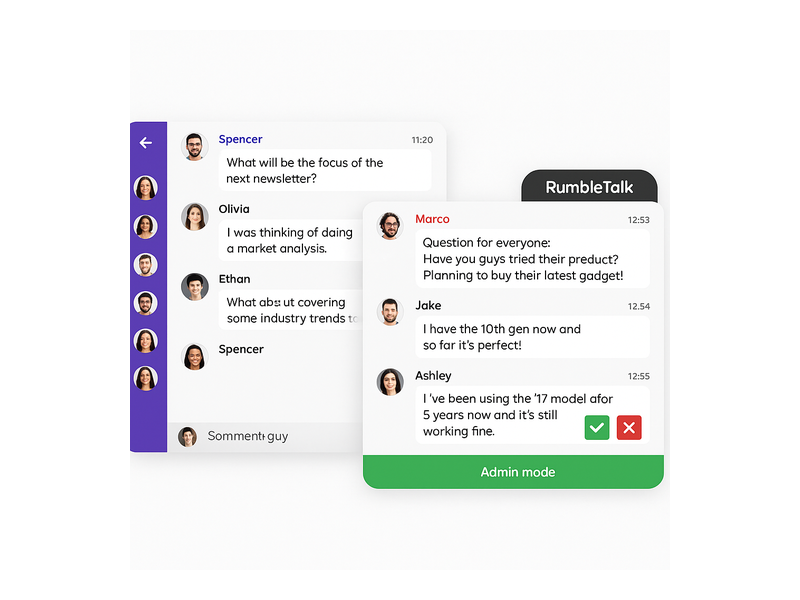
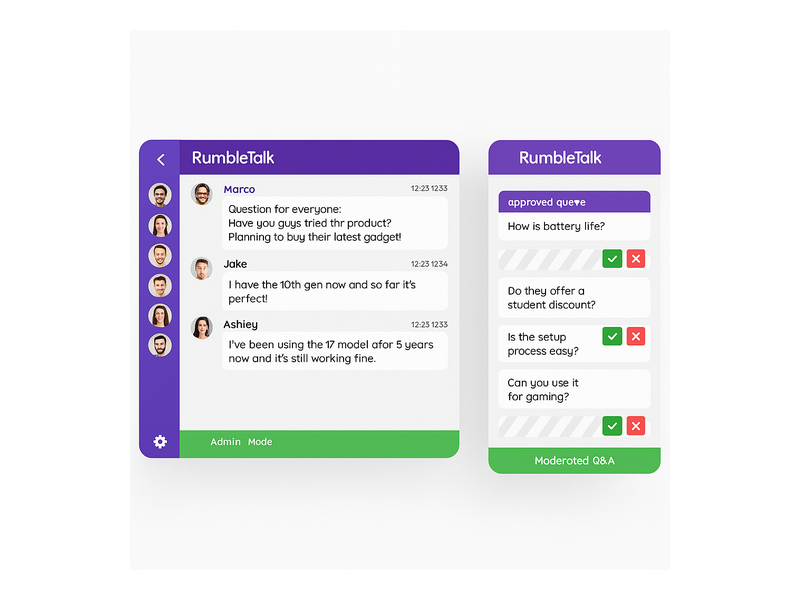
RumbleTalk delivers this through multiple chat formats tailored to different discussion needs: open group chat for broad community interaction, Members Chat for gated subscriber communities, Moderated Q&A for structured expert sessions, Social Chat for audience-driven conversations, Private Chat for one-on-one engagement, and Queued Chat for organized speaker queues at live events.
Why Your Website Needs a Community Discussion Platform
Websites with active community features retain visitors longer, see higher return-visit rates, and generate more user-created content than purely static sites. A community discussion platform is not a luxury feature — it is increasingly a baseline expectation for audiences who are used to participating, not just consuming. Brands that provide a native discussion space own the conversation. Brands that do not cede it to social media platforms they cannot control or measure.
Drive Audience Retention and Long-Term Loyalty
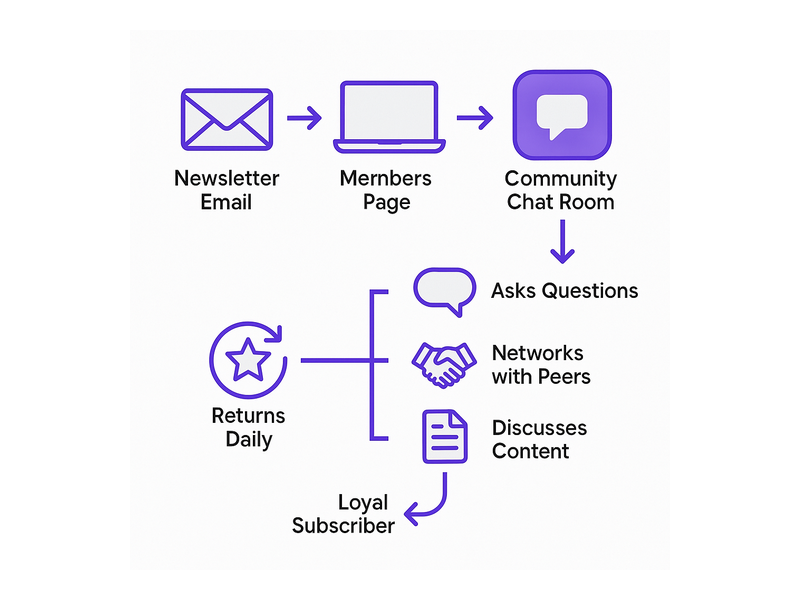
When users have a reason to return — an ongoing conversation, a scheduled live Q&A, a community they belong to — your site becomes a destination. A community discussion platform creates social gravity: the more members engage, the more valuable the space becomes for everyone. New members join because the community is active; existing members stay because it keeps growing. This network effect is one of the most powerful growth mechanisms available to website operators.
Because RumbleTalk is fully hosted, there is no server maintenance, no database overhead, and no engineering lift beyond pasting an embed code. Your team focuses on community management and content strategy, not infrastructure.
Activate Real-Time Engagement During Live Events
Live events — webinars, product launches, sports broadcasts, radio shows, virtual conferences, and online classes — are natural moments for community discussion. A community discussion platform that activates during these events transforms passive viewers into active participants. Attendees can react, submit questions, cheer on speakers, and connect with each other in the moment, creating shared experiences that extend well beyond the broadcast itself.
RumbleTalk is purpose-built for high-volume live scenarios. Features like the message rate limiter, Admin Mode broadcast lock, and Moderated Q&A queue ensure that even audiences of thousands can have structured, meaningful exchanges without devolving into noise.
Key Features of RumbleTalk’s Community Discussion Platform
Not all community discussion solutions are equal. RumbleTalk is designed with specific capabilities that address the real-world challenges of running an engaged online community at scale.
Moderation Tools Built for Any Scale
The biggest challenge for any community discussion platform is keeping conversations civil, on-topic, and valuable. RumbleTalk gives administrators a comprehensive moderation toolkit that works at both small and enterprise scale:
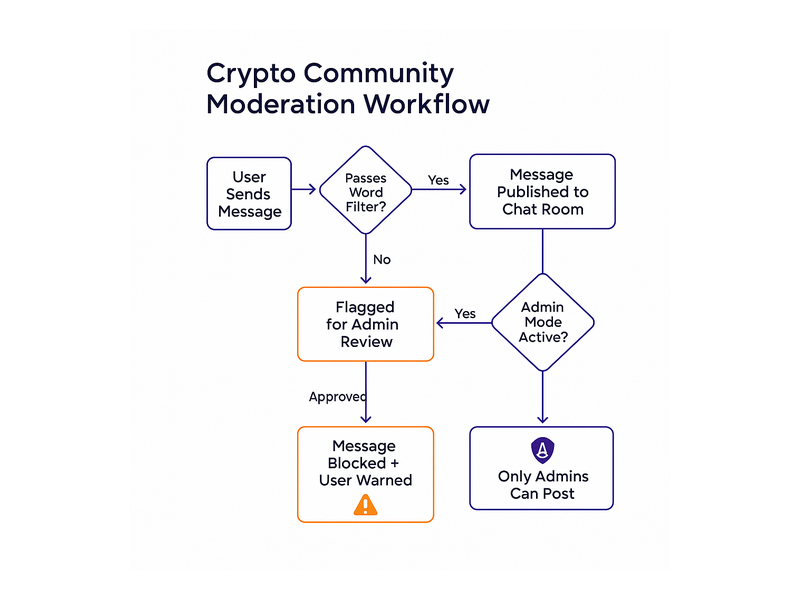
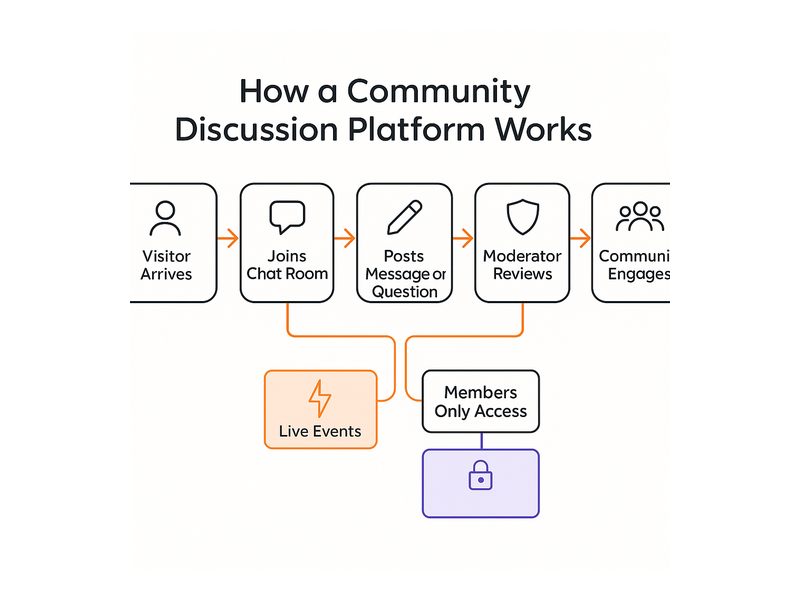
- Message pre-approval — moderators approve or reject each message before it goes live, ideal for brand-sensitive events or regulated industries.
- User banning and muting — remove disruptive participants instantly without interrupting the rest of the community.
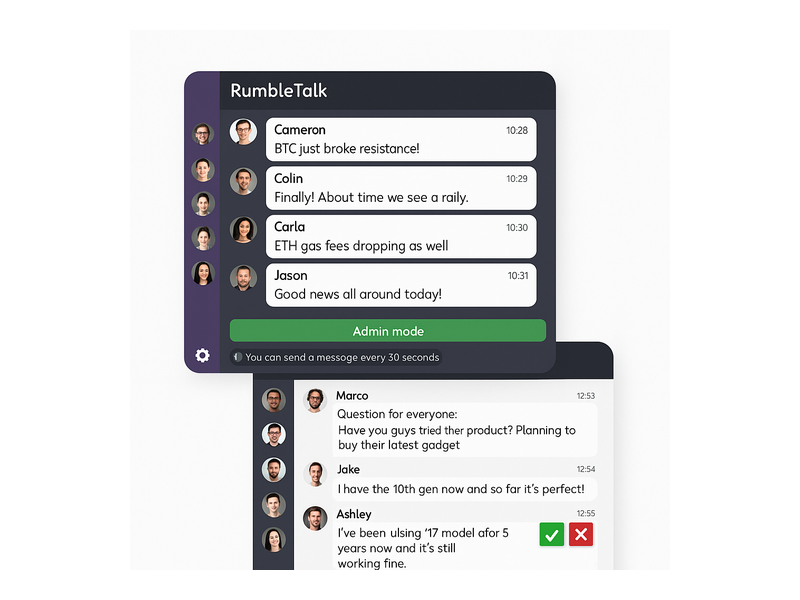
- Admin Mode — lock the chat so only admins can broadcast, perfect for announcements, keynotes, or official Q&A moments.
- Rate limiting — set a minimum interval between messages per user to prevent spam and flooding during high-traffic events.
- Profanity filter — automatically catch and block inappropriate language before it appears in the community feed.
- Message history controls — configure how far back the chat history is visible, keeping the feed focused on current discussion.
These controls make RumbleTalk a trustworthy community discussion platform for organizations that cannot afford moderation failures — educational institutions, financial platforms, healthcare providers, and enterprise event teams all depend on this layer of control.
Multiple Chat Formats for Every Discussion Scenario
A single chat type rarely satisfies every community discussion need. RumbleTalk offers a suite of formats so you can match the tool to the moment:
- Group Chat — open community discussion where all members participate simultaneously. Ideal for ongoing community channels, fan groups, and brand communities.
- Moderated Q&A — structured format where users submit questions and moderators select which ones get answered. Perfect for expert panels, AMAs, and live webinars.
- Members Chat — gated discussion accessible only to authenticated or paying members, protecting your premium audience and fostering exclusivity.
- Social Chat — a more informal, social-media-style experience for lightweight audience interaction and event back-channels.
- Private Chat — one-on-one messaging between users or between users and support or sales staff.
- Queued Chat — organized speaker queues that let audience members raise their hand and speak in turn, ideal for town halls and panel discussions.
Single Sign-On and Authentication
For members-only communities, seamless login is critical. RumbleTalk supports SSO integration so users who are already authenticated on your website are automatically recognized inside the chat. This eliminates friction, improves the experience, and keeps your community discussion platform inside your security perimeter — no separate credentials, no abandoned registrations.
Branding and Deep Customization
Your online community should feel like a native part of your site, not a bolted-on widget. RumbleTalk offers deep visual customization — colors, fonts, background images, button styles, avatar sets — so the chat interface matches your brand identity precisely. White-label deployments are supported for agencies and platform builders who need a fully branded discussion environment for their clients.
Use Cases: Where a Community Discussion Platform Drives Real Results
Understanding the contexts where a community discussion platform has the highest impact helps website owners prioritize their deployment and get maximum return from day one.
E-Learning and Online Education
Educational platforms benefit enormously from a structured community discussion platform. Students who can ask questions in real time, collaborate with peers in study groups, and engage with instructors during live lessons retain information significantly better and complete courses at higher rates. RumbleTalk’s Moderated Q&A format is particularly effective for online classes: instructors control the pace and focus of discussion while every student still has a voice. Members Chat enables cohort-specific rooms so different classes or enrollment tiers do not cross-pollinate.
Media, Broadcasting, and Podcasting
Radio stations, podcasts, YouTube channels, and news sites all have passionate audiences who want to talk with each other — not just consume. Embedding a discussion space on your site linked to your broadcast schedule turns consumption into participation. Listeners become community members, and your platform becomes the canonical home for the conversation that surrounds your content. This keeps your audience off social media platforms and inside your ecosystem where you can engage, monetize, and measure them directly.
Financial and Trading Communities
Traders and investors who discuss markets on third-party forums can be brought home to a space you own and control. A community discussion platform embedded on a financial site lets analysts share insights, members debate strategies, and moderators keep conversations accurate and compliant. RumbleTalk’s rate limiting and pre-approval moderation are especially valuable in this high-stakes, regulation-sensitive context.
Virtual Events and Conferences
The normalization of virtual and hybrid events has made real-time community discussion a core audience expectation. Attendees want to interact, not just watch. With RumbleTalk embedded in your event platform, you can run networking rooms, panel Q&As, sponsor booths with live chat, and post-session discussion channels — all within a single, fully branded community discussion platform that your team controls end to end.
Membership Sites and Subscription Communities
Subscription businesses and membership platforms face constant pressure to demonstrate ongoing value to paying members. A community discussion platform is one of the highest-leverage ways to do this: members who are actively engaged with each other churn at dramatically lower rates than those who only consume static content. RumbleTalk’s Members Chat creates exclusive discussion spaces that reinforce the value of membership every time a subscriber logs in.

How to Embed RumbleTalk on Your Website in Minutes
Setting up a fully functional community discussion platform with RumbleTalk takes minutes, not months. No DevOps expertise is required:
- Create your chat room — sign up at RumbleTalk.com and configure your chat type, branding, moderation rules, and access controls in the admin dashboard.
- Copy the embed code — RumbleTalk generates a short JavaScript snippet that you paste into any webpage, CMS template, or web application.
- Configure authentication — connect your existing login system via RumbleTalk’s SSO API to enable seamless member authentication.
- Go live — your community discussion platform is immediately active. Invite members, promote your first event, and start building your audience.
RumbleTalk is compatible with WordPress, Wix, Squarespace, Webflow, custom HTML sites, and virtually any modern web platform. There is no server to provision, no database to manage, and no scaling concern — RumbleTalk handles all infrastructure automatically. For step-by-step setup guidance, visit the RumbleTalk Getting Started knowledge base.
Best Practices for Running a Thriving Community Discussion Platform
Technology enables community — strategy builds it. Here are the best practices that consistently separate high-engagement communities from ones that stagnate:
Schedule Regular Live Events
Communities thrive on routine and anticipation. Schedule weekly Q&A sessions, monthly expert panels, or daily open chat hours to give members a recurring reason to show up. Announce these events in advance via email and social channels. Over time, live events become a habit for your audience, and your community discussion platform becomes the place they gather to participate.
Appoint and Train Dedicated Moderators
The quality of any discussion community is directly tied to the quality of its moderation. Invest in training moderators to enforce community guidelines consistently, welcome new members personally, highlight great contributions publicly, and de-escalate conflicts quickly before they spiral. Well-moderated communities retain members; poorly moderated ones drive them away.
Use Engagement Data to Refine Your Strategy
RumbleTalk’s admin analytics show when your community is most active, which topics generate the most discussion, and how moderators are performing over time. Use this data to optimize your event calendar, identify your most valuable contributors, and spot early warning signs of community health issues. Data-driven community management is what scales a discussion platform from a chat box into a genuine business asset.
Integrate Discussion Into Your Content Strategy
The best-performing communities are not siloed from the rest of the business. Use post-session Q&A transcripts as blog content and FAQ articles. Surface trending community questions as content briefs for your editorial team. Feature active community members in case studies and testimonials. This creates a virtuous cycle: community activity generates content, content attracts new members, and new members deepen the discussion.
For a deeper strategic framework, see Community Building Playbooks: How to Turn Your Website Chat into a Loyal Audience — a practical guide to audience growth strategy using embedded chat.
Start Building Your Community Discussion Platform Today
If you are ready to transform your website into a destination where your audience connects, contributes, and keeps coming back, RumbleTalk is the community discussion platform built for the job. With flexible chat formats for every scenario, enterprise-grade moderation tools, seamless embedding across any platform, and a proven track record across media, education, finance, and live events, RumbleTalk gives your team everything needed to build a thriving, branded online community — without the infrastructure overhead or engineering complexity.
Explore the full range of community and social engagement features at RumbleTalk for Social Communities and Membership Sites, or create your free chat room today and launch your first live discussion in minutes. Your audience is already talking — give them a home on your website.