
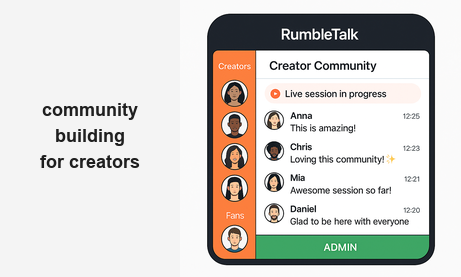
Community building for creators, educators, and platform owners is not a single strategy. A content creator building a fan community has different needs than a university professor running an online course, and both are different from a SaaS founder growing a user community. What they share is a need for live, on-site conversation — and a set of playbooks for making that conversation productive.
The platforms that succeed at community building are not the ones with the most content. They are the ones that make their audience feel heard. A tutorial library, a course curriculum, a feature set — none of these build loyalty on their own. What builds loyalty is the moment a member posts something and gets a real response. That moment is what separates a website from a community.
RumbleTalk gives creators, educators, and platform owners the infrastructure for those moments — embedded directly on their websites, under their control, customized for their audience. Here is how each group can use it.
Playbook for Content Creators: Turn Fans into a Loyal Audience
Content creators face a specific community problem: their audience is scattered. Fans watch on YouTube, follow on Instagram, listen on Spotify, and comment on TikTok — but none of those platforms belong to the creator. The algorithm controls distribution. The platform owns the data. The creator has no direct line to their audience when a platform changes its rules or reduces reach.
Embedding a chat room on your own website changes that equation. When fans register and participate in your on-site community, you have a direct relationship with them that no algorithm can interrupt. Here is the creator playbook for making that community thrive.
Weekly Fan Q&A Sessions
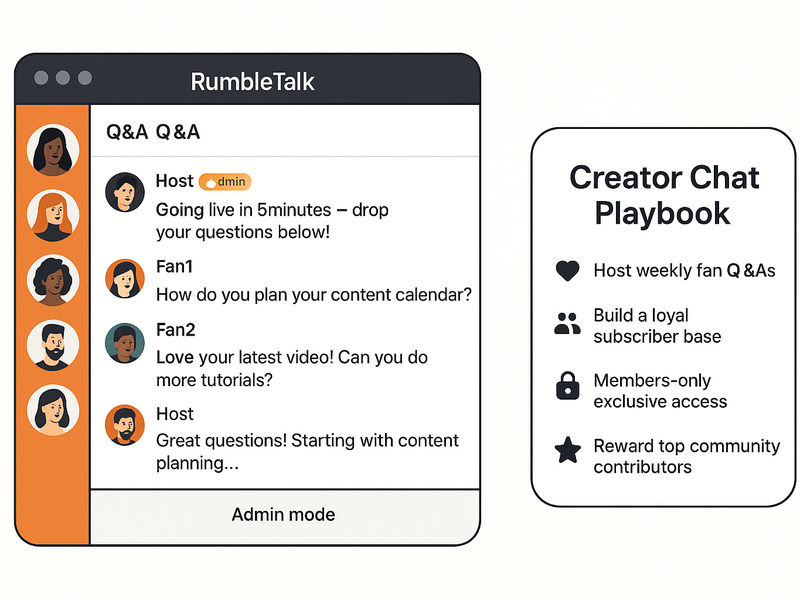
Pick a recurring time and show up in your chat room. Announce it across your channels — this week’s Q&A is Tuesday at 7 PM inside the community. Members who want access to you directly will register on your site and return every week. Over time, the Q&A becomes the anchor of your community calendar. Members plan around it. They invite others. The session becomes a recurring reason to visit your website that your content alone cannot provide.
Members-Only Chat for Supporters
Create a private room accessible only to your paid supporters, newsletter subscribers, or Patreon members. This room is where you share early access, behind-the-scenes context, and exclusive discussions that are not available to the general public. The exclusivity drives upgrades from casual fans to paying supporters — not because you are withholding content, but because you are offering something more valuable: access to you and to each other.
Playbook for Educators: Make Learning a Conversation
Online education has a retention problem. Students who learn passively — watching videos, reading transcripts, completing quizzes alone — drop out at high rates. Students who learn in community — asking questions, getting peer feedback, discussing concepts with classmates — complete courses and return for more. The difference is conversation.
For educators running courses, membership sites, or online schools, embedding a chat room is one of the highest-impact things they can do for student outcomes. Here is the educator playbook.
Structured Class Discussions with Slow-Down Chat
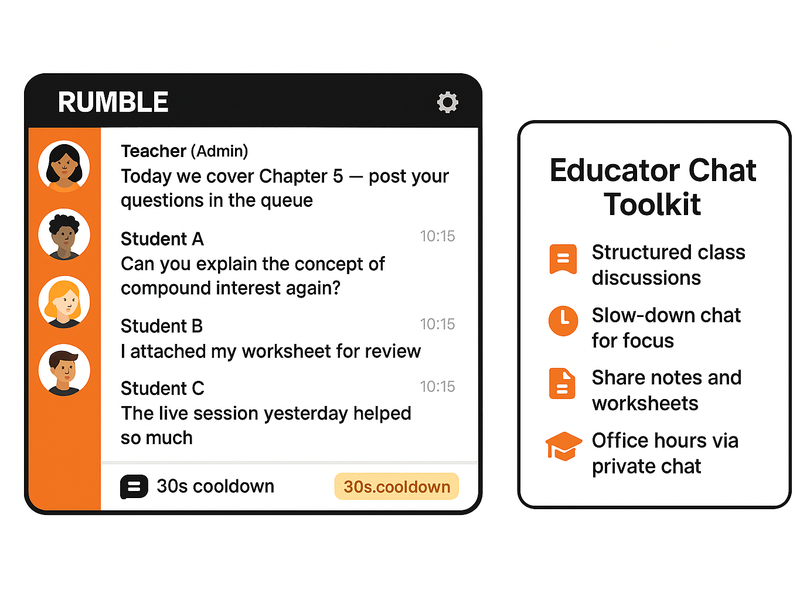
When you open the chat room for a live lesson or a discussion prompt, the volume can quickly become unmanageable. Slow-Down Chat lets you set a cooldown period between student messages — every student can still contribute, but the pace of the conversation stays readable. This is particularly effective for discussion prompts where you want thoughtful responses rather than rapid reactions.
Office Hours via Private Chat
Set aside weekly office hours and let students open private chats with you directly. Private chat in RumbleTalk supports text, file sharing, and audio and video calls — so a student can show you their work, share their screen, and get real-time feedback without switching to Zoom or Google Meet. Everything stays inside your platform. Students who get direct access to an instructor are far more likely to complete a course and enroll in the next one.
Peer Study Groups with Separate Chat Rooms
Create separate chat rooms for different cohorts, modules, or study groups. Students in Month 1 of a program get one room. Advanced students get another. Alumni get a third. Each room has its own culture and level of conversation. Students in the early room see the advanced room as something to aspire to. Alumni in the senior room become mentors and advocates. The community develops layers that reward continued participation.
Playbook for Platform Owners: Make Community a Product Feature
For SaaS founders, marketplace operators, and membership platform owners, community is not a marketing tactic. It is a product feature — one that directly affects churn, lifetime value, and word-of-mouth growth. When users have a community inside your product, they are not just paying for features. They are paying for relationships, peer support, and access to a network that they cannot replicate elsewhere.
Integrate Chat with Your User Authentication
RumbleTalk’s SSO integration connects your existing login system to the chat room. When a user is logged into your platform, they are automatically logged into the community. No second account. No friction. The chat room becomes a seamless part of the product experience — not a separate tool that requires separate credentials.
This matters for platform owners because friction kills community participation. Every extra step between a user and a chat room reduces the chance they will engage. SSO removes all of those steps.
Use Moderated Q&A for Product Announcements
When you launch a new feature, push an update, or make a major product decision, give your users a structured space to respond. Activate Admin Mode to keep the announcement focused, then open the floor for a moderated Q&A. Users feel heard. Your team learns what questions need better answers in the documentation. And the whole exchange is visible to every member of the community — building transparency and trust in your product decisions.
Build Power User Communities
Create a separate chat room for your most active users — power users, beta testers, or long-term subscribers. Give them early access to features and a direct line to your product team. These users become your most vocal advocates because they feel like insiders, not customers. The community room is where that relationship is built and maintained. It is also where you get the most actionable product feedback you will ever receive.
The Common Thread: Conversation Creates Loyalty
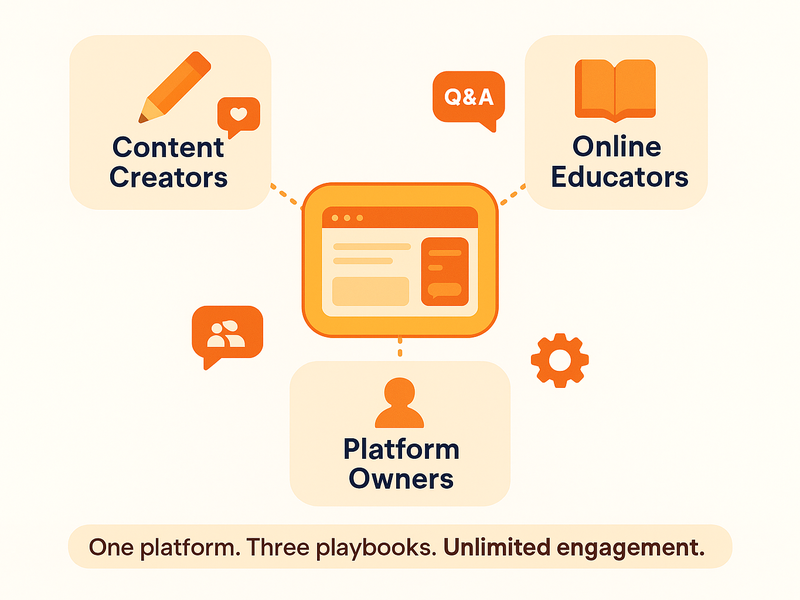
Whether you are a creator with 10,000 YouTube subscribers, an educator running an online course, or a platform owner with 500 paying users, the dynamic is the same. Passive audiences are fragile. They leave when something better comes along. Community members are resilient. They stay because they have relationships, context, and history inside your platform — and leaving means losing all of that.
The playbooks in this post are not magic. They require consistency and presence. You have to show up for the Q&A. You have to moderate the early weeks carefully. You have to set the cultural tone before the community is large enough to sustain itself. But the investment compounds. A community that has been growing for six months is significantly harder to compete with than one that launched last week.
RumbleTalk gives you the infrastructure. The chat is embeddable, customizable, and scalable. The moderation tools — pre-approval queues, Admin Mode, Slow-Down Chat — give you control over the experience as the community grows. The SSO integration removes friction for your registered users. The private chat deepens relationships beyond the group room.
Get Started with Your Community Playbook
You do not need a large audience to start. Some of the strongest communities began with fewer than a hundred members who showed up every week because the conversation was worth having. Start with one chat room, one recurring session, and one clear reason for your audience to participate. Build from there.
RumbleTalk’s community building for creators, educators, and platform owners starts with a free trial and an embed code that takes minutes to add to your website.
Start building your community with RumbleTalk — your audience is already out there, waiting for a place to connect.