
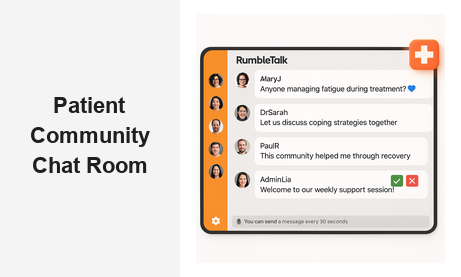
A well-designed patient community chat room can be the difference between a healthcare website that merely informs and one that genuinely transforms patient outcomes. When patients connect with each other in real time — sharing experiences, asking questions, and finding peer support — the value of that community extends far beyond any single clinical interaction. RumbleTalk helps healthcare organizations, patient advocacy groups, medical education platforms, and telehealth providers embed a fully moderated patient community chat room directly into their website, with no coding required and no complex infrastructure to manage.
Why Healthcare Organizations Need a Patient Community Chat Room
Patients managing chronic illness, navigating a rare diagnosis, or recovering from surgery share a universal need: human connection. A patient community chat room fills that gap by giving people a safe, structured space to connect in real time. Unlike static forums or email newsletters, live group chat creates a sense of presence — the digital equivalent of a support group meeting, available around the clock from any device.
For healthcare organizations and digital health platforms, the business case is equally compelling. An active patient chat community increases time-on-site, deepens brand loyalty, and generates authentic peer-to-peer content. When patients feel heard and supported on your platform, they return consistently. They refer others. They become long-term advocates for your organization’s mission.
Consider the specific scenarios where a patient community chat room adds measurable value:
- Chronic illness support groups — Communities for diabetes, MS, heart disease, or autoimmune conditions need regular, facilitated peer connection to sustain engagement.
- Post-op recovery communities — Surgical patients benefit enormously from shared real-world recovery experiences and practical peer advice.
- Rare disease networks — When conditions affect few people globally, connecting patients across geographies via live chat becomes clinically and emotionally critical.
- Mental health platforms — Moderated group sessions and structured peer check-ins benefit from real-time, controlled chat formats.
- Telehealth providers — Digital health companies can create patient follow-up communities, waiting room chats, and ongoing education channels.
The depth of engagement possible in a live patient support community simply cannot be replicated by email newsletters or social media comment threads. Real-time conversation builds the kind of relationship that keeps patients loyal to a platform for years.
Key Features That Define an Effective Patient Community Chat Room
Not all chat tools are built for sensitive healthcare environments. A proper patient community chat room requires specific capabilities that balance openness with safety, and community energy with administrative control. Here is what to look for — and what RumbleTalk delivers out of the box.
Real-Time Moderated Group Chat
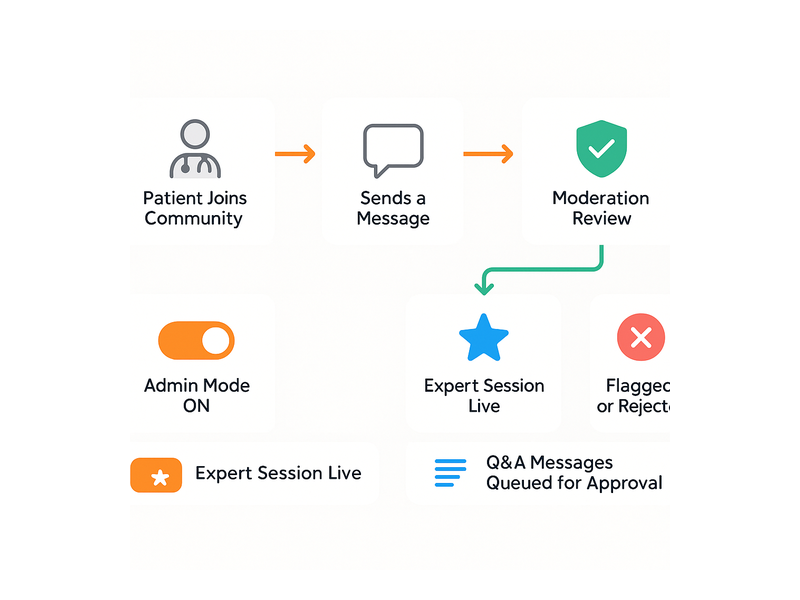
RumbleTalk’s Group Chat product forms the backbone of any patient community chat room. Messages appear instantly, creating the momentum of a live conversation. Administrators monitor discussions in real time, remove harmful content, mute disruptive participants, or activate Admin Mode — a setting that locks the chat so only designated speakers can post. This is invaluable during moderated sessions with healthcare professionals or subject-matter experts addressing patient questions.
Moderated Q&A for Expert-Led Sessions
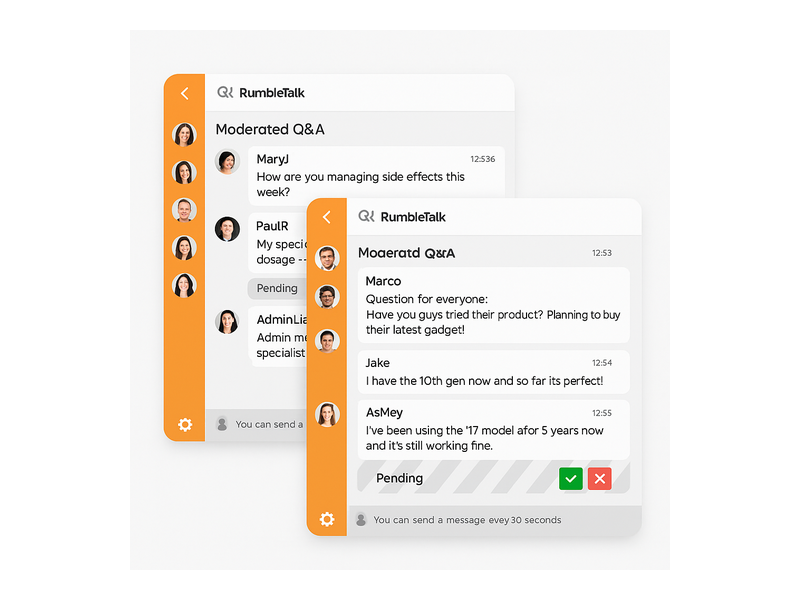
Healthcare providers running live educational sessions or patient Q&A panels can use RumbleTalk’s Moderated Q&A feature. Questions flow in from the patient audience, but only approved messages are published to the group — keeping the session focused and preventing the spread of misinformation. For a patient community chat room hosting monthly specialist-led webinars, this single feature delivers enormous operational value.
Members-Only Access Control
Patient communities frequently require authentication to protect sensitive discussions. RumbleTalk’s Members Chat restricts entry to verified members only, ensuring your online health community stays private and trusted. SSO (Single Sign-On) integration syncs with your existing user database, so only logged-in, verified patients gain access. This creates a secure environment where members feel genuinely safe sharing personal health journeys and treatment experiences.
Private One-on-One Chats
Beyond group interaction, RumbleTalk supports Private Chat channels so individual members of your patient community can connect directly with peers within the same platform. This adds meaningful depth to the community experience without driving users away to external messaging apps — keeping all engagement anchored to your website.
Queued Chat for Structured Community Sessions
RumbleTalk’s Queued Chat feature enables structured conversation formats — ideal for moderated panel discussions, peer support roundtables, or group therapy-style sessions where participants take turns contributing. In a patient community chat room serving mental health users or high-needs populations, this ordered approach supports safe, considerate peer sharing without the overwhelming noise of an open chat feed.
How RumbleTalk Powers Your Patient Community Chat Room
Setting up a patient community chat room with RumbleTalk is straightforward for any organization, regardless of technical resources. The platform is designed to embed into any website — WordPress, Wix, Squarespace, or a custom-built application — using a single JavaScript snippet or a no-code plugin. Administrators manage everything from a cloud-based dashboard: user permissions, chat themes, moderation rules, and session scheduling.
Here is what the deployment process looks like in practice:
- Create your chat room — Configure your Group Chat or Members Chat room and select a visual theme that matches your healthcare brand identity.
- Set access permissions — Decide whether the patient community is open to all visitors, requires registration, or uses SSO login to sync with your existing patient portal.
- Embed on your website — Paste the embed code into any HTML page or activate the WordPress plugin. No developer involvement needed.
- Appoint moderators — Grant admin rights to healthcare staff, community managers, or trained patient advocates who will facilitate conversations.
- Go live and scale — Your patient chat community is ready to grow from day one.
For telehealth platforms looking to add community features alongside clinical tools, RumbleTalk’s telehealth chat solution provides purpose-built configuration options including waiting room chats, post-appointment follow-up rooms, and provider-to-patient group channels — making it the natural infrastructure choice for digital health organizations.
Organizations can also create multiple segmented chat rooms — one for each patient group, condition category, or program phase — all managed from a single RumbleTalk administrator account. A large hospital network can deploy a unified patient community chat room infrastructure across dozens of disease-specific landing pages without managing separate tools for each distinct community.
Moderation Tools for Safe Patient Community Chat Rooms
In any health-related community, moderation is not optional — it is an operational necessity. An online health community without proper oversight can quickly become a source of dangerous misinformation, harmful peer advice, or emotionally toxic interactions. RumbleTalk’s moderation suite is built for high-stakes community environments where every message carries real weight.
Admin Mode and Message Approval Queues
When a live session requires strict editorial control — such as a specialist Q&A webinar or a mental health group check-in — administrators activate Admin Mode within the patient community chat room. All incoming messages are queued for review before publication. Moderators approve, reject, or edit submissions before the community sees them. This gives healthcare organizations complete control over the information environment during sensitive live events.
User Banning and Real-Time Muting
Disruptive or abusive participants can be muted temporarily or banned permanently directly from the chat interface, without navigating to a separate admin panel. The action happens in real time, within the chat window itself. For a patient health community where emotional safety is paramount, this immediacy makes a critical difference in protecting vulnerable members. Detailed guidance on managing participant behavior is available in the RumbleTalk knowledge base guide on banning users.
Slow Mode and Message Throttling
For large patient communities with hundreds of active members, slow mode prevents message floods that make conversations unreadable. Administrators set a cooldown period between messages per user — for example, one message every 30 seconds — keeping the chat manageable and reducing noise during peak activity periods. This is especially valuable during awareness campaigns, live events, or any session that attracts a surge of community participation.
Profanity Filters and Custom Content Rules
RumbleTalk includes configurable word filters that automatically block or flag messages containing prohibited terms. Healthcare organizations customize these filters to catch medical misinformation keywords, emotionally harmful language, or platform-specific violations — keeping the patient community environment clean without requiring constant manual monitoring. Moderators can focus on meaningful facilitation rather than reactive content removal.
Real-World Use Cases for Patient Community Chat Rooms
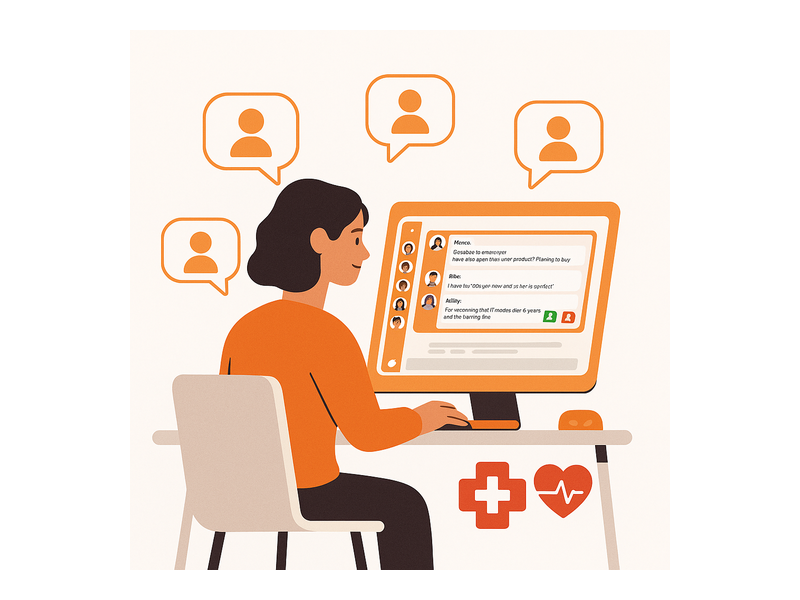
The versatility of a patient community chat room makes it applicable across dozens of healthcare and wellness verticals. Here are the most impactful community formats organizations are running on RumbleTalk today.
Chronic Disease Support Networks
Organizations supporting patients with diabetes, heart disease, lupus, or multiple sclerosis create dedicated chat rooms segmented by condition or treatment stage. Members connect regularly, share coping strategies, discuss medication experiences, and celebrate recovery milestones — within a moderated environment that prevents the circulation of dangerous peer-sourced medical advice. The sustained daily engagement builds a level of community trust that no social media group can replicate.
Oncology Patient Networks
Cancer patients and survivors benefit enormously from peer connection. A patient community chat room gives them a place to ask the questions they hesitate to bring to their oncologist, find emotional solidarity with people who truly understand the experience, and access peer-sourced practical knowledge. Hospitals and cancer centers hosting these rooms as a value-added patient service strengthen relationships that extend far beyond the clinical encounter — and often result in significantly higher patient satisfaction scores.
Mental Health and Peer Support Platforms
Digital mental health platforms increasingly rely on community interaction as a therapeutic modality in its own right. A moderated patient chat community enables structured peer support groups, daily check-in sessions, and community coping exercises. RumbleTalk’s Queued Chat feature supports structured group formats where participants take turns sharing in an orderly, emotionally safe environment — mirroring the format of facilitated in-person therapy groups.
Patient Advocacy Organizations
Advocacy groups for rare diseases or underserved patient populations use patient community chat rooms to build the sense of belonging that isolated patients desperately need. When geography makes in-person support groups impossible, a live online patient community bridges that gap at scale — connecting individuals across cities, countries, and time zones who would never otherwise find each other.
Healthcare Education and Wellness Platforms
Medical education portals, patient university programs, and wellness platforms embed a patient community chat room alongside course content — allowing learners to discuss material in real time with peers and expert facilitators. This transforms passive content consumption into an active community learning experience, measurably increasing course completion rates, content return visits, and overall platform stickiness.
The broader strategies behind building lasting online communities are explored in detail in this guide on community building playbooks for website platforms — with direct applications to patient engagement and healthcare community management.
Setting Up a Patient Community Chat Room That Scales
One of RumbleTalk’s defining operational advantages is its platform agnosticism. Whether your healthcare website runs on WordPress, a custom React application, Squarespace, or a proprietary CMS, embedding a patient community chat room takes minutes rather than weeks. The embed code is a single JavaScript snippet that drops into any HTML page — or, for WordPress, the plugin handles it automatically.
Customization options ensure the chat environment feels native to your brand and community culture:
- Custom color themes, logos, and chat window backgrounds to match your healthcare brand
- Configurable user roles — administrator, moderator, verified member, and guest tiers
- Multilingual interface support for international patient communities
- Fully mobile-responsive design that works across all devices and screen sizes
- API access for deeper integration with patient portals, CRM systems, or EHR platforms
- Chat history export and analytics for community health monitoring and reporting
As your patient community grows, RumbleTalk scales with it. Add new chat rooms for emerging condition-specific groups, spin up event rooms for awareness campaigns, or create a hierarchy of public community spaces and private member-only rooms — all managed from one admin account with no additional infrastructure cost.
Privacy and Security in Your Patient Chat Community
Healthcare organizations rightly prioritize data governance when selecting any third-party technology platform. A patient community chat room handles sensitive personal health conversations, making it essential that the underlying platform maintains strong data security practices. RumbleTalk stores chat data securely and gives administrators control over data retention policies, access logs, and user data management.
Access controls — including SSO integration and members-only permissions — ensure that only authenticated participants can enter a private patient community environment. This prevents unauthorized observers from accessing sensitive health discussions. Combined with moderation tools, content filtering, and role-based permissions, RumbleTalk gives healthcare organizations the controls they need to operate a patient community platform with confidence and organizational accountability.
Build Your Patient Community Chat Room Today
A patient community chat room is more than a website feature — it is a strategic investment in patient outcomes, platform loyalty, and long-term community health. When patients feel genuinely connected, supported, and heard on your platform, they engage more deeply, return more frequently, and advocate more passionately for your organization’s mission.
RumbleTalk makes it possible to launch a fully featured, professionally moderated patient community chat room without a dedicated development team, without complex hosting infrastructure, and without compromise on safety or user experience. From chronic illness support networks to oncology communities to mental health peer platforms, RumbleTalk scales to meet your patient community exactly where they are — and help them grow.
Ready to build a patient community that truly thrives? Visit RumbleTalk to explore plans, request a live demo, and start creating the patient community chat room your audience deserves — today.